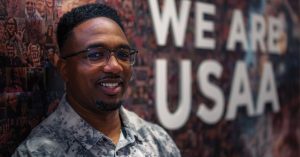
Product Manager at USAA
Former Navy officer
urges military job seekers to sell their leadership experience to civilian
employers.
By Warren Duffie
As a junior officer on
two Navy vessels, Travis Peace, 30, learned how to make snap decisions. Often,
situations arose for which he had limited details but still had to react
quickly – the lives of his Sailors and millions of dollars of equipment could
be at stake.
Despite this
pressure-cooker education, making decisions in the corporate world as a
civilian took some adjustment. Now, instead of taking the lead, he had to step
back and take a larger view of a challenge – often consulting committees and
key stakeholders.
“When I first came to
USAA, I sometimes rushed to a decision before getting all of the facts,” said Peace,
a former lieutenant. “I had to adjust to the change of pace because in the
business world, you have time to analyze a situation and digest information
thoroughly before making a judgment. I had to learn to slow down. However, my
quick reactions still help when I’m asked a question and have to think on my
feet.”
On the Job
Peace found solid
footing in USAA’s Junior Military Officer Career Development Program. USAA
provides a variety of insurance, investment, banking and financial planning
services. The career development program recruits junior military officers and
places them in different business areas over three years – allowing them to
learn how the organization operates.
“JMOS have a lot of
leadership and management experience,” Peace said. “This program provides them
with exposure to the business world.”
Currently in his first
year, Peace works as a product manager in the Home Circle division – which
provides members with advice and services regarding home ownership, buying,
selling and renting. He partners with USAA’s marketing, communications and
development teams to highlight current products and promote new ones.
In Uniform
A native of San
Antonio, Texas, Peace played guard for the U.S. Naval Academy’s football team.
After graduating in 2003, he was assigned to USS Bataan, where he completed
surface warfare officer training. He later attended nuclear engineering school
in Charleston, S.C., and Saratoga Springs, N.Y. He was then assigned to USS
George Washington as a nuclear engineer.
The Transition
By 2008, Peace knew he
didn’t want to make the Navy a career. He read a variety of books about leaving
the military and rubbed elbows at several service academy career fairs. Before
his 2008 separation, he also took transition classes and sat through networking
lunches.
Peace landed a federal
contracting job with Parsons Corporation, working as an engineer at Fort Sam
Houston, Texas. He enrolled in the MBA program at the University of Texas at
San Antonio, where he met a West Point graduate who worked for USAA and told
him that the company was hiring.
“In the interview and
on my résumé, I really stressed my leadership and management experience, as
well as the business knowledge I had acquired through my MBA studies,” Peace
said.
One thing I would stress
to transitioning military is to push your leadership experience,” he continued.
“I wish I had done that more when I first got out. I thought I could only sell
my engineering skills and economics degree. Civilian employers really value the
intangibles that military veterans bring to the work force.”
How’d You Get
That Job?
Peace read a variety
of books about leaving the
military and rubbed elbows at several service academy career fairs. Before his
2010 separation, he also took transition classes and sat through networking
lunches.
Peace landed a federal
contracting job with Parsons Corporation, working as an engineer at Fort Sam
Houston, Texas. He enrolled in the MBA program at the University of Texas at
San Antonio, where he met a West Point graduate who worked for USAA and told
him that the company was hiring.
“In the interview and
on my résumé, I really stressed my leadership and management experience, as
well as the business knowledge I had acquired through my MBA studies.”
Peace’s Advice
Do your homework.
“Before you interview with a company, learn all you can about it. Come up with
some discussion questions. Show them you want to work there.”
Don’t sell yourself
short. “The military has provided you with unique experiences and skills.
Promote them and show what you can bring to a company.”
USAA
Founded: 1922
HQ: San Antonio
Employees: 22,200
2010 Revenue: $17.9
billion
www.usaa.comDid You Know?
- USAA has ranked in
the top 10 eight years straight since the G.I. Jobs Top 100 Military Friendly
Employers® was instituted in 2003 and has been in its top 5 the last four
years. The Fortune 500 group of companies is also ranked #1 on Military Spouse
magazine’s 2011 Top 10 Military Spouse Friendly Employers® award and has held
the top spot three years running.
- USAA’s
Junior Military Officer Career Development Program recruits junior military
officers and places them in different business areas over three years –
allowing them to learn how the organization operates.
Where
Were You on Sept. 11, 2001?
“I had just started my
2nd class year (junior) at the Naval Academy. I was in a statistics class
(which happened to have computers with Internet access at each desk) when
rumors started going around the classroom that a rocket or airplane had hit the
towers. Classes were obviously cancelled for the rest of the day, and we were
all ordered to stayed locked in our rooms in Bancroft Hall (the dorm). My
roommates and I watched everything unfold on our personal computers.”