Driver at Con-way Truckload
Airman lands lucrative career covering ground for Con-way Truckload.
By Warren Duffie
Like that famous Johnny Cash song, Michael Osborn has “been everywhere, man.”
A driver with Con-way Truckload, the former Air Force staff sergeant has rolled through every state except Hawaii and criss-crossed some of Canada’s most stunningly beautiful terrain. Osborn, 32, has hauled nearly everything for Con-way Truckload – a subsidiary of Con-way Inc., a $4.3 billion leader in the transportation and logistics industry.
“I’ve transported cosmetics worth more than a million dollars as well as DVDs that were about to be released to the general public,” he said. “I remember one year, I helped haul every Halloween costume being sold by one of the country’s largest retailers. Talk about a lot of costumes.”
On the Job
Based in Joplin, Mo., Osborn specializes in “just-in-time” deliveries. These require him and a driving partner to travel to client sites, pick up freight, and transport the hauls non-stop to their destination. Aside from meals and small breaks, the pair doesn’t stop, taking turns driving so they can sleep.
“Each day is different,” Osborn said. “I’ve done 600-mile runs and 1,500-mile runs. We can only drive up to 11 hours on one day, so my partner and I are very good about switching off, so we can get enough rest and follow industry regulations. Our hauls can be anything – toilet paper, auto parts, food, HAZMAT equipment, anything that needs to get someplace quickly.”
Osborn begins his shift at 2000, when he wakes up and his partner pulls into a truck stop for a meal. The pair eats, fills out paperwork, and inspects the truck. Osborn then takes the wheel while his partner retires to the cab to sleep. Osborn drives until 0800, with a couple of short breaks to eat and stretch his legs, before switching with his partner.
“I’m on the road for two to three weeks at a time,” Osborn said. “But the more time on the road, the more money you make and the more vacation time you accrue. It’s tough being away from home so much, but I’m used to that from the military. The military also taught me the importance of organizing my time and proper planning. Delivering loads on time is a huge deal in this industry.”
In Uniform
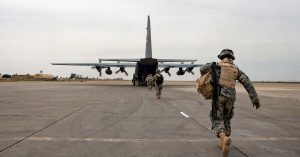
After graduating from high school in 1997, Osborn didn’t want to sit around doing nothing like many of his friends. He enlisted in the Air Force because he heard that branch had the best quality of life. After boot camp, he completed aircraft weapons systems training at Sheppard Air Force Base.
During his military career, Osborn was stationed in Virginia, Japan, Korea and Las Vegas. In 2007, desiring a new professional challenge, he decided it was time to pursue a civilian livelihood.
The Transition
“I have to travel and always move,” Osborn said. “I wanted a civilian job that would allow me to do so. The trucking industry looked like the ideal choice, plus it pays better than a lot of civilian jobs.
“I did a lot of research on which companies would be good to work for,” he continued. “I paid particular attention to comments from drivers. Con-way’s name kept coming up as a great company. So I contacted them. By the time I separated from the Air Force, I had lined up a spot in their truck driver training program. When I left the military, I took a week’s vacation and then went to Con-way’s driver training – which consisted of a month of classroom instruction, followed by three weeks on the road with a trainer.”
Did You Know?
- Con-way Inc. and its subsidiaries – including Con-way Truckload – operate from more than 440 locations across North America and in 18 countries across five continents.
- Veterans can use their GI Bill benefits to pay for Con-way’s truck driver training program.
- Con-way offers increased pay to veterans who have experience driving trucks in the military.
Osborn’s Advice:
Plan ahead. “Figure out where you want to live and what industry you want to work in. Transitioning without a game plan, especially in this economy, is a dangerous move.”
Retain your military bearing. “Courtesy and professionalism are huge assets in the civilian world. If you treat people with the respect you demonstrated in the military, you’ll look like a star performer from day one.”
Keep contact with your military friends. “It’s a great way to build a strong professional and personal network.”
How’d You Get That Job?
“I have to travel and always move,” Osborn said. “I wanted a civilian job that would allow me to do so. The trucking industry looked like the ideal choice, plus it pays better than a lot of civilian jobs.
“I did a lot of research on which companies would be good to work for,” he continued. “I paid particular attention to comments from drivers. Con-way’s name kept coming up as a great company. So I contacted them. By the time I separated from the Air Force, I had lined up a spot in their truck driver training program. When I left the military, I took a week’s vacation and then went to Con-way’s driver training – which consisted of a month of classroom instruction, followed by three weeks on the road with a trainer.”