
You spent years learning a language most civilians will never understand.
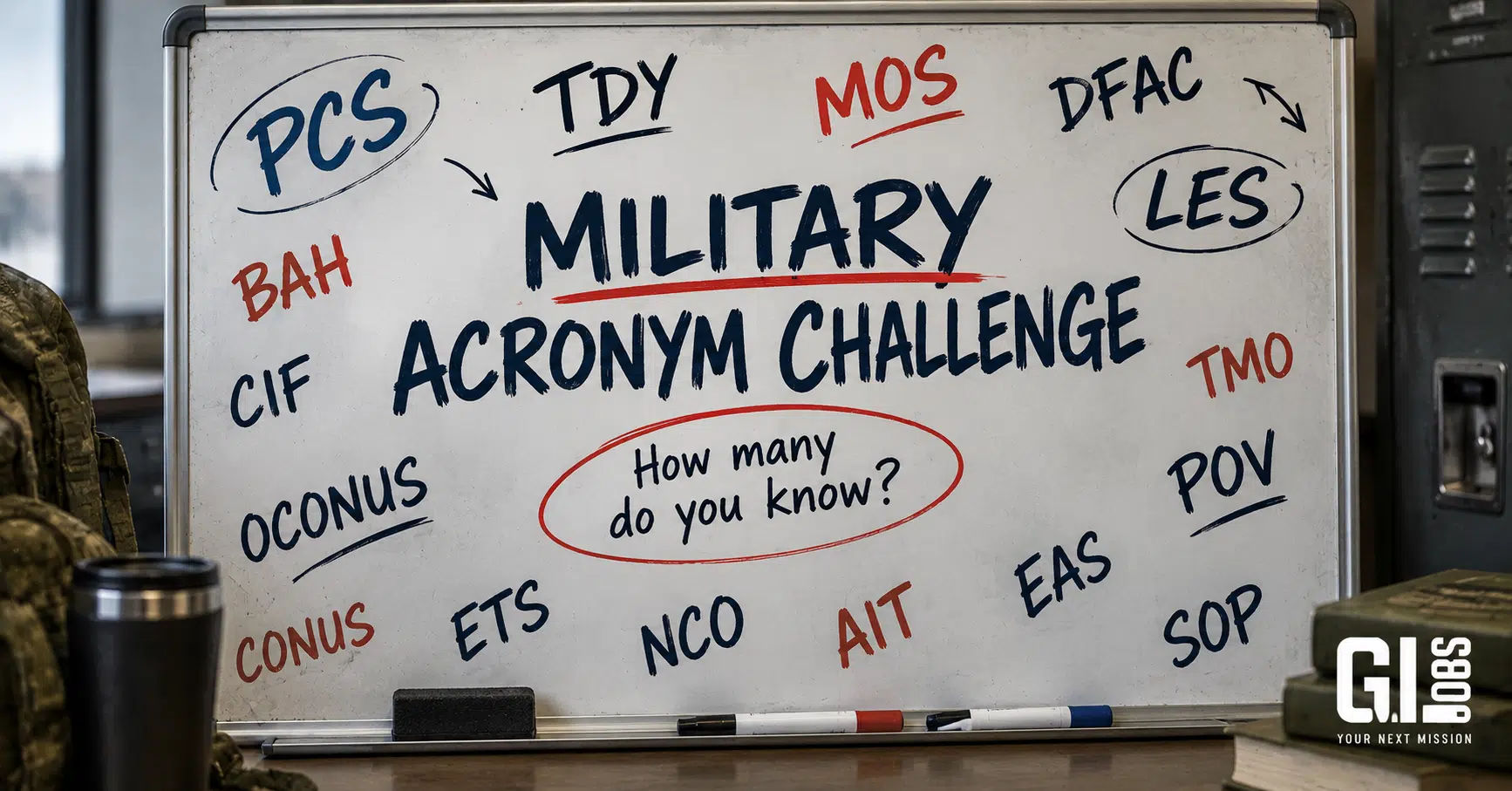
PCS. TDY. LES. DFAC. MOS. ETS.
At some point, you stopped even noticing how ridiculous it sounded. Someone could tell you to grab your CAC, check your LES, head to the DFAC and be back before COB, and somehow that qualified as a perfectly normal sentence.
Then you got out.
Maybe it’s been six months. Maybe it’s been 20 years. Either way, we’re about to find out how much completely unnecessary military vocabulary is still taking up permanent real estate in your brain.
Welcome to the G.I. Jobs Military Acronym Challenge.
The rules are simple:
- No Googling.
- No checking your old paperwork.
- No texting the buddy who somehow remembers everything.
- Give yourself one point for every acronym you can correctly identify.
- Keep your score. You’ll need it at the end.
- Scroll to the bottom for the answers.
Ready?
Round 1: Come On. You Better Know These.
We’ll start easy.
If you’ve forgotten these already, civilian life may have officially claimed you.
1. PCS
The military’s way of saying, “Congratulations. Everything you own is going in boxes again.”
2. TDY
Depending on the assignment, this either meant a welcome change of scenery or eating takeout in a hotel room for three weeks.
3. MOS
For the Army and Marines, this is the code that described your military job. Other branches use their own systems and terminology, which we’ll get to.
4. PT
You may now voluntarily exercise at a perfectly reasonable hour of the day. What a concept.
5. BAH
Possibly the only acronym on this list that made you immediately interested in the number following it.
Round 2: Still Got It
No more warm-up.
6. LES
Your military pay stub—and the document you probably stared at trying to figure out why a number had suddenly changed.
7. MRE
Technically food.
We will leave it there.
8. NCO
The people who knew how things actually got done.
9. CONUS
Continental United States
10. OCONUS
Outside the Continental United States
Round 3: It’s Been a Minute
This is where we start separating “I served” from “I can still decipher an operations brief.”
11. ETS
A date you may have known with greater precision than your own anniversary.
12. POV
Or, as civilians call it, “your car.”
One of the military’s greatest talents was creating an acronym for something that already had a perfectly good name.
13. SOP
The official way something is supposed to happen.
Whether that’s how it actually happened is another question.
14. DFAC
Pronunciation debates may now begin in the comments.
15. CIF
Where gear came from.
And where, during clearing, someone could look at a piece of equipment you’d protected with your life for six years and inform you that it was somehow not clean enough.
Round 4: Welcome to the Branch Wars
Here’s where things get interesting.
Military terminology isn’t universal. Every branch has its own language, traditions and acronyms—and something that’s obvious to one Veteran may be completely foreign to another.
See how many of these you can get.
16. AFSC
The Air Force’s system for identifying career fields and specialties.
Army Veterans who confidently answered “MOS” lose no points, but the Air Force would like a word.
17. NEC
A Navy classification used to identify specialized skills, training and qualifications beyond a Sailor’s rating.
18. EAS
A term especially familiar to Marines counting down toward civilian life.
19. AIT
For Army Veterans, the training that came after Basic Combat Training and taught the skills associated with an MOS.
20. TIS
The amount of time you’ve served—which has a funny way of sounding either incredibly long or surprisingly short depending on whether you’re remembering it from inside or outside the military.
So, How’d You Do?
- 1: Permanent Change of Station
- 2: Temporary Duty
- 3: Military Occupational Specialty
- 4: Physical Training
- 5: Basic Allowance for Housing
- 6: Leave and Earnings Statement
- 7: Meal, Ready-to-Eat
- 8: Noncommissioned Officer
- 9: Continental United States
- 10: Outside the Continental United States
- 11: Expiration Term of Service
- 12: Privately Owned Vehicle
- 13: Standard Operating Procedure
- 14: Dining Facility
- 15: Central Issue Facility
- 16: Air Force Specialty Code
- 17: Navy Enlisted Classification
- 18: End of Active Service
- 19: Advanced Individual Training
- 20: Time in Service
Final score: ___ / 20
0–5: Civilianization Complete
We barely recognize you.
You have successfully cleared a significant portion of military terminology from your brain and replaced it with things like PTO, 401(k) and whatever Microsoft Teams is doing today.
6–10: A Little Rusty
It’s still in there.
Give yourself another five minutes around Veterans and you’ll probably start remembering things you haven’t thought about in years.
11–15: Respectable
You can still translate when necessary.
You’ve forgotten just enough military language to function comfortably in civilian society without losing the ability to understand what’s happening when an old buddy starts telling a story.
16–19: You Still Speak Military
You’ve been out for years and somehow your brain refuses to surrender this information.
There are probably important passwords you’ve forgotten while “OCONUS” remains permanently accessible.
20/20: Suspicious
Either you’re still serving, you got out approximately 11 minutes ago, or you’re the Veteran everyone calls when they can’t remember what an acronym means.
Either way, we respect it.
What Are the Most Common Military Acronyms?
Military acronyms vary by service branch, career field and assignment, but terms like PCS, TDY, BAH, LES, CONUS, OCONUS and POV are used widely across the military. Others—like MOS, AFSC and NEC—are specific to particular branches or personnel systems. If you’ve spent enough time around the military, you’ve probably learned hundreds without realizing it.
Now Try to Stump Us
Here’s the real challenge.
Drop one military acronym in the comments that you think Veterans from the other branches won’t know.
Army, Navy, Air Force, Marine Corps, Coast Guard, National Guard, and Space Force Veterans: this is your opportunity.
Give us the acronym—but don’t give away the answer immediately.
Let’s see which branch can confuse everyone else the fastest.
And if we get enough good ones, we’ll use them for Round 2.
One Place You Don’t Want All Those Acronyms: Your Resume
Knowing military terminology is one thing.
Expecting a civilian hiring manager to understand it is another.
Acronyms, military job titles and service-specific terminology are some of the easiest things to overlook when you’re translating military experience for a civilian employer.
Your resume shouldn’t require a decoder ring.
If you’re working on your next career move, read 15 More Military Terms You Should Remove From Your Resume and our guide to Military Resume vs. Civilian Resume to make sure the experience you’ve earned actually makes sense to the person reading it.
Because “SME responsible for SOP development supporting CONUS operations” might make perfect sense to you.
The recruiter reviewing 75 resumes today? Maybe not.
Once you’re ready, join our monthly Virtual Job Fair and take your next step in this crazy, civilian world.