
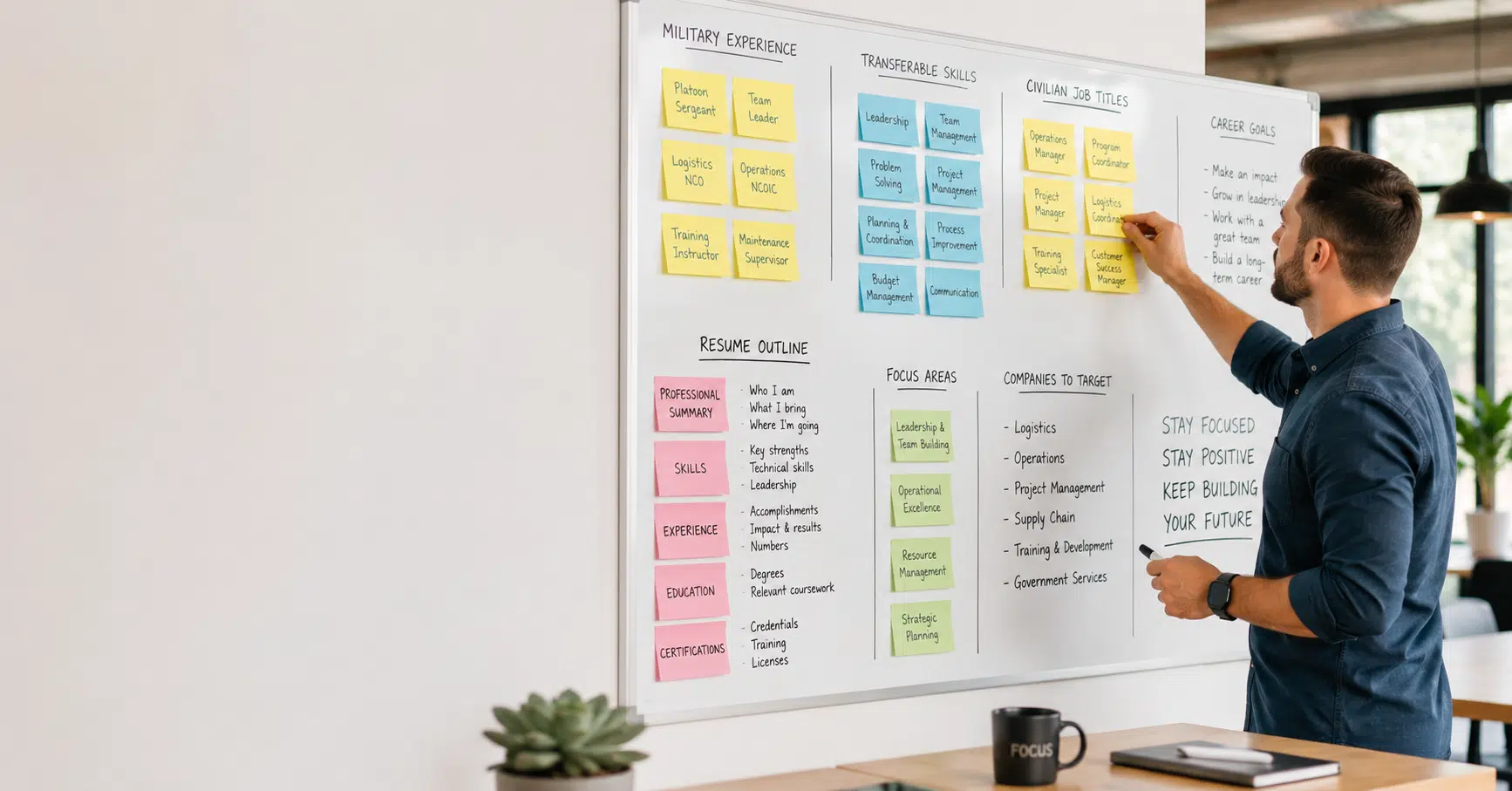
How to Turn Your Military Resume Into One Civilian Employers Understand
What’s the difference between a military resume and a civilian resume?
A military resume often includes military terminology, ranks, duty stations, and job titles that civilian employers may not understand. A civilian resume translates military experience into plain language, emphasizes transferable skills, and focuses on measurable accomplishments that align with the job being sought.
How do you convert a military resume into a civilian resume?
To convert a military résumé into a civilian résumé, replace military jargon with plain language, highlight transferable skills, focus on measurable accomplishments, tailor your résumé to each job description, and include keywords that match the employer’s needs. The goal is to help hiring managers quickly understand the value of your military experience.
You spent years building leadership experience, solving complex problems, managing teams, and completing missions under pressure.
So why aren’t employers calling?
For many veterans, the answer isn’t a lack of qualifications.
It’s the résumé.
One of the biggest mistakes transitioning service members make is assuming civilian recruiters understand military language.
They usually don’t.
Terms like MOS, NCOIC, Battalion S-4, or Platoon Sergeant carry significant meaning within the military—but outside it, they can create confusion instead of confidence.
Your résumé isn’t meant to impress another service member.
It’s meant to help a hiring manager quickly understand how your experience solves their business problems.
The good news?
You don’t need to reinvent your career.
You simply need to translate it.
This guide explains the biggest differences between military and civilian résumés, shows how to communicate your experience effectively, and shares practical strategies that can help you earn more interviews.
Remember:
- Military experience is valuable—but it must be translated into civilian language.
- Employers care more about skills and accomplishments than ranks or military terminology.
- Strong civilian résumés emphasize measurable results.
- Every résumé should be tailored to the position you’re applying for.
- Simple language almost always performs better than military jargon.
Why Many Military Résumés Don’t Get Interviews
Here’s something most veterans never hear:
Recruiters don’t reject military résumés because they dislike military experience.
They reject them because they don’t understand them.
Most recruiters spend less than 10 seconds scanning a résumé during an initial review.
If those first few seconds are filled with unfamiliar acronyms, military occupational codes, and organizational terminology, they may struggle to identify how your experience fits the position.
That’s why translation—not simplification—is so important.
You’re not minimizing your service.
You’re making it understandable.
The Biggest Differences Between Military and Civilian Résumés
Military resume often includes:
- Rank
- MOS/AFSC/Rating
- Unit designations
- Duty stations
- Awards
- Military abbreviations
- Chain of command
- Operational language
These details matter within the military.
But they don’t automatically communicate value to civilian employers.
Civilian Résumé
Instead, employers look for:
- Leadership
- Project management
- Budget responsibility
- Team size
- Process improvement
- Technical expertise
- Measurable achievements
- Business impact
Rather than focusing on where you served, focus on what you accomplished.
Stop Writing Military Titles—Start Writing Civilian Roles
Instead of:
Platoon Sergeant
Try:
Operations Supervisor
Instead of:
Logistics NCO
Try:
Supply Chain Coordinator
Instead of:
Battalion S-4
Try:
Logistics Operations Manager
You aren’t changing history.
You’re translating responsibilities into language employers immediately understand.
Employers Hire Results, Not Job Titles
One of the biggest improvements veterans can make is shifting from duties to accomplishments.
Instead of:
Responsible for vehicle maintenance.
Write:
Managed maintenance operations for a fleet of 85 vehicles, improving equipment readiness while coordinating schedules for a team of 18 technicians.
Numbers immediately give employers context.
Whenever possible include:
- Dollar amounts
- Team size
- Budgets
- Equipment managed
- Projects completed
- Time saved
- Performance improvements
- Safety records
Concrete achievements are far more memorable than generic responsibilities.
Before & After Resume Example
Military Version
Served as Battalion S-4 NCOIC responsible for logistical readiness.
Civilian Version
Managed logistics operations supporting more than 600 personnel, overseeing inventory, transportation planning, vendor coordination, and supply distribution while maintaining operational readiness.
Which one would make more sense to someone who’s never served?
Exactly.
Side-by-Side: Military Resume vs. Civilian Resume
Here’s a quick comparison that illustrates how recruiters view each style.
| Military Resume | Civilian Resume |
|---|---|
| Uses military ranks and job titles | Uses civilian job titles or functional descriptions |
| Heavy use of acronyms (MOS, NCOIC, AFSC) | Plain language anyone can understand |
| Lists duties | Highlights accomplishments and measurable results |
| Written for military audiences | Written for hiring managers and recruiters |
| Focuses on chain of command | Focuses on business impact and transferable skills |
| One résumé for every job | Tailored to each position |
GI Jobs Tip: Your résumé should answer one question quickly: “Why are you the right person for this specific job?”
10 Military Terms to Replace Immediately
Many recruiters have never served in the military. Help them understand your experience by translating—not erasing—your service.
| Instead of… | Try… |
|---|---|
| Platoon Sergeant | Operations Supervisor |
| Battalion S-4 | Logistics Operations Manager |
| NCOIC | Team Leader or Department Supervisor |
| MOS | Military Occupational Specialty (briefly explain if relevant) |
| TDY | Temporary Business Travel |
| Convoy Operations | Transportation & Fleet Coordination |
| Property Book | Asset & Inventory Management |
| Training NCO | Training Coordinator |
| Mission Planning | Project Planning |
| Force Protection | Risk Management & Safety Operations |
The goal isn’t to hide your military background. It’s to make your experience instantly understandable.
Pass the Recruiter’s 10-Second Test
Recruiters often spend only a few seconds on an initial résumé review.
Before sending yours, ask someone with no military experience to answer these questions after reading only the first half of the first page:
- What type of work did this person do?
- What problems can they solve?
- What industry would they fit into?
- What are their biggest accomplishments?
- Would I interview them?
If the answers aren’t obvious, revise your résumé.
Tailor Every Resume to the Job
One of the biggest mistakes veterans make is creating one résumé and sending it everywhere.
Instead, customize each version.
Review the job description and identify:
- Required skills
- Frequently used keywords
- Software or certifications
- Leadership expectations
- Industry terminology
Then adjust your résumé to reflect those priorities—truthfully and naturally.
A logistics role and a project management role may value many of the same experiences, but they’ll describe them differently.
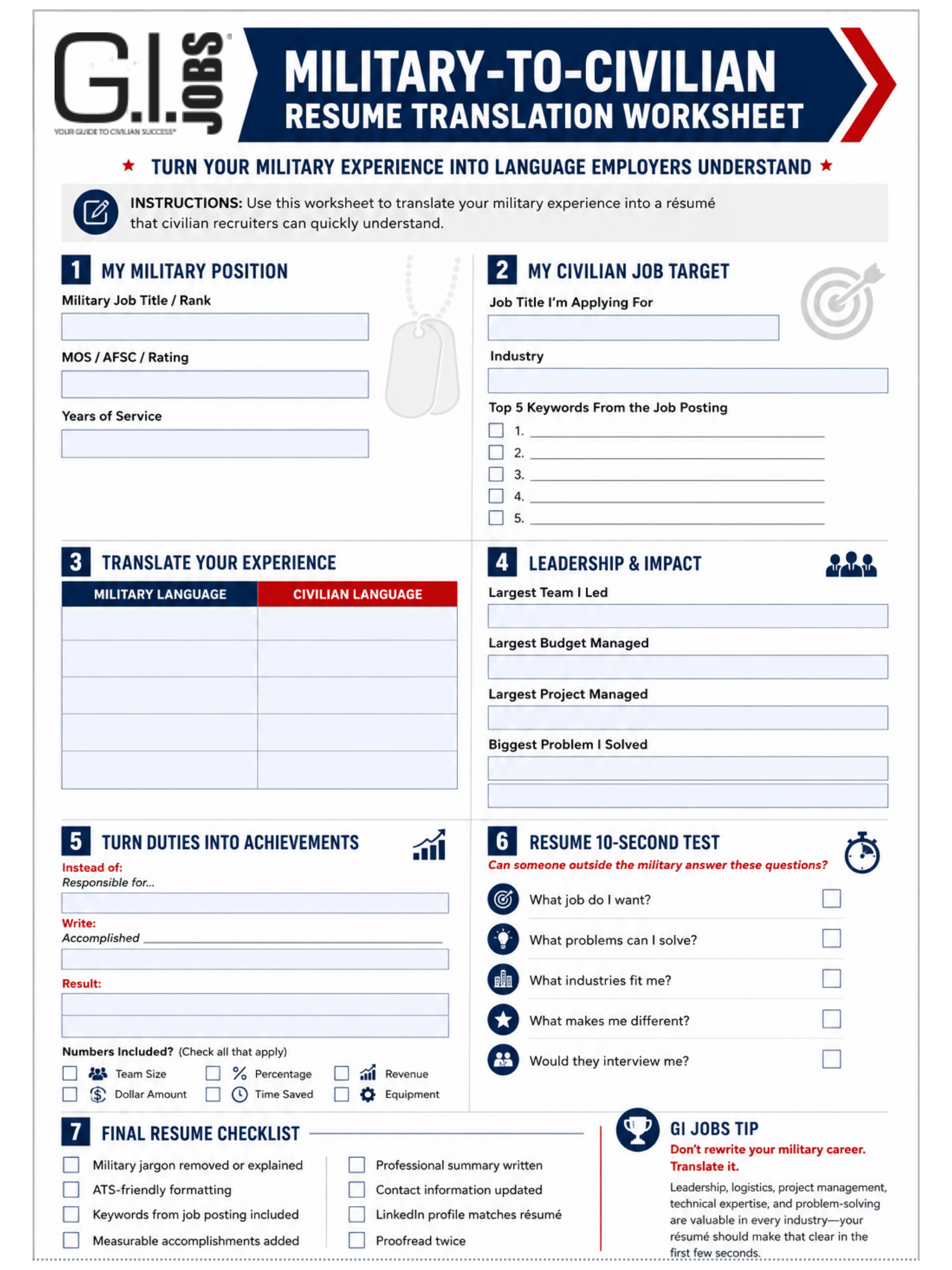
📄 Free Download: Military-to-Civilian Resume Translation Worksheet
Turning military experience into civilian language isn’t always easy.
We’ve created a printable worksheet to help you:
✓ Translate military job titles into civilian roles
✓ Identify measurable accomplishments
✓ Match your experience to job descriptions
✓ Prepare a recruiter-friendly résumé
👇 Download the free worksheet, fill it out, and start building your civilian résumé today.
Want more free career tools like this? Sign up here and we’ll send them over
Optimize for Applicant Tracking Systems (ATS)
Many employers use Applicant Tracking Systems to screen résumés before a recruiter ever sees them.
To improve your chances:
Use keywords naturally
If the job description mentions:
- Project Management
- Inventory Control
- Team Leadership
...and you have those skills, include those exact phrases where appropriate.
Keep formatting simple
Avoid:
- Text boxes
- Complex graphics
- Multi-column layouts
- Decorative fonts
Clean formatting is easier for ATS software to read.
Save in the requested format
If the employer requests a PDF, send a PDF.
If they ask for a Word document, follow those instructions.
Attention to detail matters.
Show Results, Not Responsibilities
One of the fastest ways to strengthen your résumé is replacing duty statements with accomplishments.
Weak Example
Responsible for supervising soldiers.
Strong Example
Led a team of 22 personnel responsible for logistics operations supporting time-sensitive missions while maintaining a 98% equipment readiness rate.
The second example tells a recruiter much more.
Whenever possible, include:
- Percentages
- Dollar amounts
- Team size
- Project scope
- Time savings
- Efficiency improvements
- Awards tied to measurable performance
Common Resume Mistakes Veterans Make
Including Too Much Military Jargon
Remember who your audience is.
Most recruiters don't know military terminology—and they shouldn't have to.
Listing Every Duty Assignment
Your résumé isn't a military record.
Focus on the experiences most relevant to the job you're pursuing.
Forgetting a Professional Summary
A strong summary helps recruiters immediately understand who you are.
In just a few sentences, explain:
- Your years of leadership experience
- Your core strengths
- Your target role
- The value you bring
Ignoring LinkedIn
Many recruiters review LinkedIn before scheduling interviews.
Your profile should reinforce—not contradict—your résumé.
Keep job titles, dates, and accomplishments consistent across both.
Veteran Resume Checklist
Before clicking "Submit," ask yourself:
✅ Have I translated military terms into civilian language?
✅ Does my résumé focus on accomplishments instead of duties?
✅ Have I included measurable results?
✅ Did I tailor it to this specific job?
✅ Is it easy for someone outside the military to understand?
✅ Does my LinkedIn profile match my résumé?
✅ Have I proofread it carefully?
If you answered "no" to any of these, take a few extra minutes before applying.
Your Military Experience Is an Advantage
Your military experience isn't something you need to hide.
It's something you need to communicate effectively.
Leadership.
Problem-solving.
Adaptability.
Accountability.
Project management.
Teamwork.
Those are qualities employers consistently value.
The challenge isn't convincing employers that veterans have those skills.
The challenge is making those strengths immediately recognizable.
A strong civilian résumé bridges that gap.
When you translate your experience into language employers understand, you're not changing your story.
You're making sure it gets heard.
Frequently Asked Questions
Should I include my military rank on my résumé?
You can mention your military service, but it's generally more helpful to emphasize your responsibilities, leadership, and accomplishments rather than relying on rank alone.
Should I list my MOS?
Only if it's relevant to the position. If you include it, explain what it means in civilian terms instead of listing only the code or title.
How long should a veteran's résumé be?
For most professionals, one to two pages is appropriate. Focus on relevant experience rather than documenting every assignment.
Do employers value military experience?
Yes. Many employers actively recruit veterans for their leadership, teamwork, adaptability, and problem-solving abilities. Presenting that experience in civilian language helps hiring managers understand its relevance.
Should every job application use the same résumé?
No. Tailoring your résumé to each position improves your chances of matching the employer's needs and performing well in applicant tracking systems.
Related GI Jobs articles: