
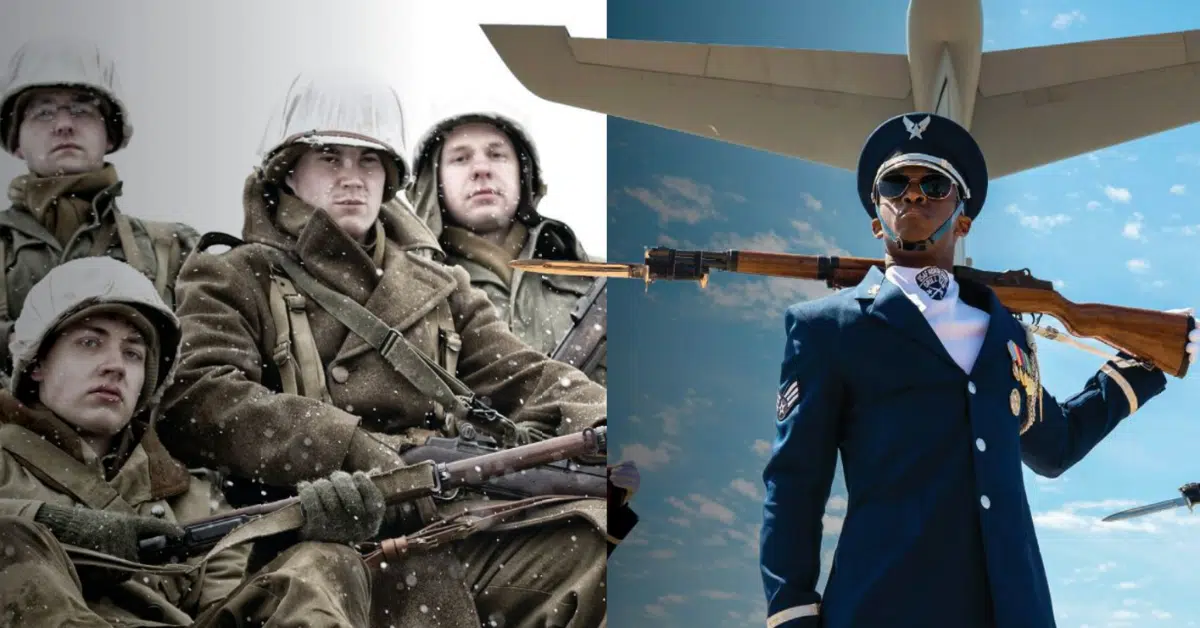
Forged in Revolution: Built by Service. From the Continental Army to today’s all-volunteer force, military service has helped shape America for 250 years.

AS AMERICA CELEBRATES ITS 250TH BIRTHDAY, the U.S. military will once again play an integral role in the nation’s story. That seems fitting. For two and a half centuries, generations of service members have defended the freedoms won during the Revolutionary War while helping shape the country that emerged from that struggle.
Today, the United States maintains the world’s most powerful military. Its origins, however, were remarkably humble. Long before independence, colonists relied on local militias to defend their communities. But the military that would eventually become the world’s premier fighting force began as a loosely organized collection of citizen-soldiers brought together to confront a growing British military presence in the colonies.
When war with Great Britain erupted in 1775, ordinary Americans – farmers, tradesmen, merchants, fishermen, students, lawyers, landowners – joined together to challenge what was then the most powerful military on earth. They faced not only British regulars but also fellow colonists who remained loyal to the Crown and Native Americans who threw in their lot with the British. The Continental Army endured extraordinary hardship during the eight-year conflict. Soldiers battled hunger, disease, brutal weather and chronic shortages of clothing, shoes, ammunition and supplies. Many went months without pay.
One of those soldiers was Connecticut native Joseph Plumb Martin, who enlisted in the Continental Army as a teenager and later recorded his experiences in a memoir.
“We marched for the Valley Forge in order to take up our winter-quarters. We were now in a truly forlorn condition – no clothing, no provisions and as disheartened as need be. We arrived at our destination a few days before Christmas. Our prospect was indeed dreary.… However, there was no remedy, no alternative but dispersion (desertion). But we had engaged in the defence of our injured country and were willing, nay, we were determined to persevere as long as such hardships were not altogether intolerable.”
Little wonder that these resilient patriots would help build the nation whose independence they secured. Three Veterans of the Revolutionary War – George Washington, James Monroe and Andrew Jackson – would later serve as president. Others who participated in the Revolution went on to hold prominent leadership positions in government and public life.
Many Veterans returned to their farms, shops and trades after the war. Others accepted land grants offered by the federal government in place of long-overdue compensation and moved westward, helping expand the young nation’s footprint and influence.
Over the next 250 years, Americans in uniform would answer the call time and again. Some fought the British once more during the War of 1812. Others served during the Indian Wars of the 19th century. American forces marched into Mexico in the 1840s. Millions fought in the Civil War, still the deadliest conflict in U.S. history.
Later generations serving in the armed forces deployed overseas during the Spanish-American War, World Wars I and II, Korea, Vietnam and conflicts in the Middle East. Millions more served during peacetime, standing watch without ever experiencing combat. Regardless of when or where they served, Veterans helped shape the nation they defended. They taught in classrooms, built businesses, strengthened communities and led workplaces. Some, including Phil Knight, Fred Smith, Sam Walton and Gordon Logan, built highly successful positions in local government, state government, Congress and the White House. Veterans have led corporations, universities, government agencies and nonprofit organizations. They have explored space, advanced medicine, pioneered life-saving technologies, championed civil rights and transformed the world of sports.
Yet the story of military service is not defined solely by famous names or historic achievements. Countless Veterans returned home without fanfare. They raised families, worked in factories as America became an economic superpower, coached youth sports, volunteered in their communities, started small businesses and mentored future generations. Their contributions rarely made headlines, but they helped strengthen the fabric of American life just as surely as those who became household names.
FAs the nation marks its 250th anniversary, the influence of military service can be found in nearly every chapter of the American story. From the citizen-soldiers who endured Valley Forge to today’s all-volunteer force, generations of Americans have stepped forward to serve something larger than themselves. The United States was forged in revolution, but it was built, strengthened and sustained by the millions who wore the uniform afterward. Their legacy remains woven into the nation’s past, present, and future.