
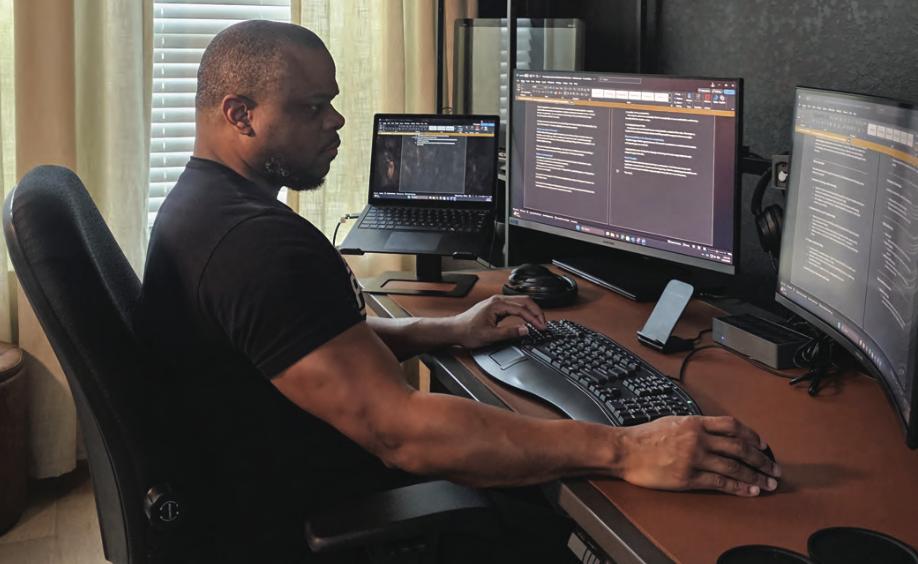
Army Veteran James Payton Jr. breaks down how AI is changing the field and where Veterans fit in.
Is cybersecurity still a smoking hot career choice for transitioning service members or veterans who what to change the path they’re on?
We asked Army Veteran James Payton Jr., who has worked in cybersecurity for 10 years.
AI is far more complex than that. It’s absolutely a powerful tool, but like every major technological leap over the past few decades, it brings real risk with
“AI has completely reshaped the cybersecurity landscape. It’s funny how two letters can flip an entire industry on its head, but of course AI is far more complex than that,” Payton said.
Let’s take a closer look.
What does a cybersecurity assessments manager actually do?
I lead a cybersecurity team responsible for evaluating the organization’s vendors and technologies to ensure they meet our compliance, security and risk-management expectations.
Is cybersecurity still a “hot” career field in 2026?
Cybersecurity is absolutely still a hot career field in 2026. The industry isn’t slowing down, and demand continues to grow as organizations face more complex threats, new regulations and the rapid rise of AI. There is some nuance, though. The field went through a hiring surge during the pandemic when companies rushed to secure remote work and cloud environments, and that breakneck pace has naturally cooled.
We’ve also seen some layoffs in certain sectors, but that doesn’t mean the demand has disappeared. The need for skilled cybersecurity professionals is still very real; it’s just a more balanced market than the frenzy we saw a few years ago.
What does the current demand look like for cybersecurity professionals compared to five or even three years ago?
The demand is still strong, but the landscape has definitely shifted. What has changed is the type of expertise companies are prioritizing. Cloud security, AI security, identity, and risk management are getting a lot more attention. So while the hiring boom has evened out, the demand remains solid and the roles themselves have become more specialized.
How has the cybersecurity field changed in the last few years?
The core of cybersecurity hasn’t changed. At the end of the day, it’s still about protecting people, information, technology and the processes that tie them together. What has changed is everything surrounding that mission. New technologies like generative and agentic AI are reshaping how organizations operate, and cybersecurity teams are being asked to enable the secure use of these tools without slowing the business down. The field is constantly shifting to keep up, and senior leaders now expect security teams to strike that balance between strong protection and smooth operations.
How has artificial intelligence changed the cybersecurity landscape?
AI has completely reshaped the cybersecurity landscape. It’s funny how two letters can flip an entire industry on its head, but of course AI is far more complex than that. It’s absolutely a powerful tool, but like every major technological leap over the past few decades, it brings real risk with it. Every advancement arrives as both an opportunity and a threat. The real challenge now is figuring out how to secure this new wave of generative and agentic AI, because while organizations are using it to move faster and smarter, threat actors are doing the exact same thing.
How are cybersecurity professionals using AI today? Cybersecurity professionals are using AI every day, not just as something to secure but as a tool that helps them work smarter and faster. I use it for simple things like cleaning up my emails and sorting through large sets of data so I can make faster, more informed decisions about how my team will evaluate new technologies.
My co-workers in threat detection lean on AI to flag unusual activity faster, and the security operations teams use it to handle the repetitive work that used to eat up their time. It’s also become a big help in risk and assessment work because it can sift through evidence and surface patterns that would take a person hours to uncover. AI is slipping into the everyday workflow in a way that makes cybersecurity teams more efficient without feeling disruptive.
Has AI reduced or increased the need for human cybersecurity professionals?
That’s always an interesting question. I don’t believe AI is going to replace large numbers of cybersecurity professionals, but it is changing the expectations for the role. The real concern is not that AI will take your job. It is that someone who knows how to use AI effectively will. The future, and honestly the present, depends on having a human who understands how to work with AI and apply good judgment on top of what the technology can do.
What skills are the most in demand right now for someones trying to enter cybersecurity?
Naturally AI security skills are becoming some of the most valuable people entering the field. Knowing how to work with prompts, understand AI systems and spot potential misuse of large language models can set someone apart quickly. Cloud security is still a major foundation too, and it remains one of the most reliable areas to build a career. Another space that is growing fast is GRC engineering.
It takes the traditional compliance and policy world and blends it with technical problem solving. For example, instead of checking evidence by hand during a cloud audit, a GRC engineer might create a script that scans that environment continuously and produces an output for the audit based on real time conditions. It is a great path for people who want to blend policy,