
Nobody hands you a business plan with your DD214.
But military service can leave you with something surprisingly useful when you decide to build a company: experience solving problems with limited information, leading people when things aren’t going according to plan, working inside complicated systems and figuring out how to keep moving when the original plan falls apart.
For some Veteran entrepreneurs, the connection goes even further.
The problem they eventually built a business around was one they first encountered while wearing the uniform.
That is what makes the stories below interesting. These aren’t simply successful business owners who also happen to be Veterans. Their military experiences influenced what they built, how they built it or the problem they decided was worth solving.
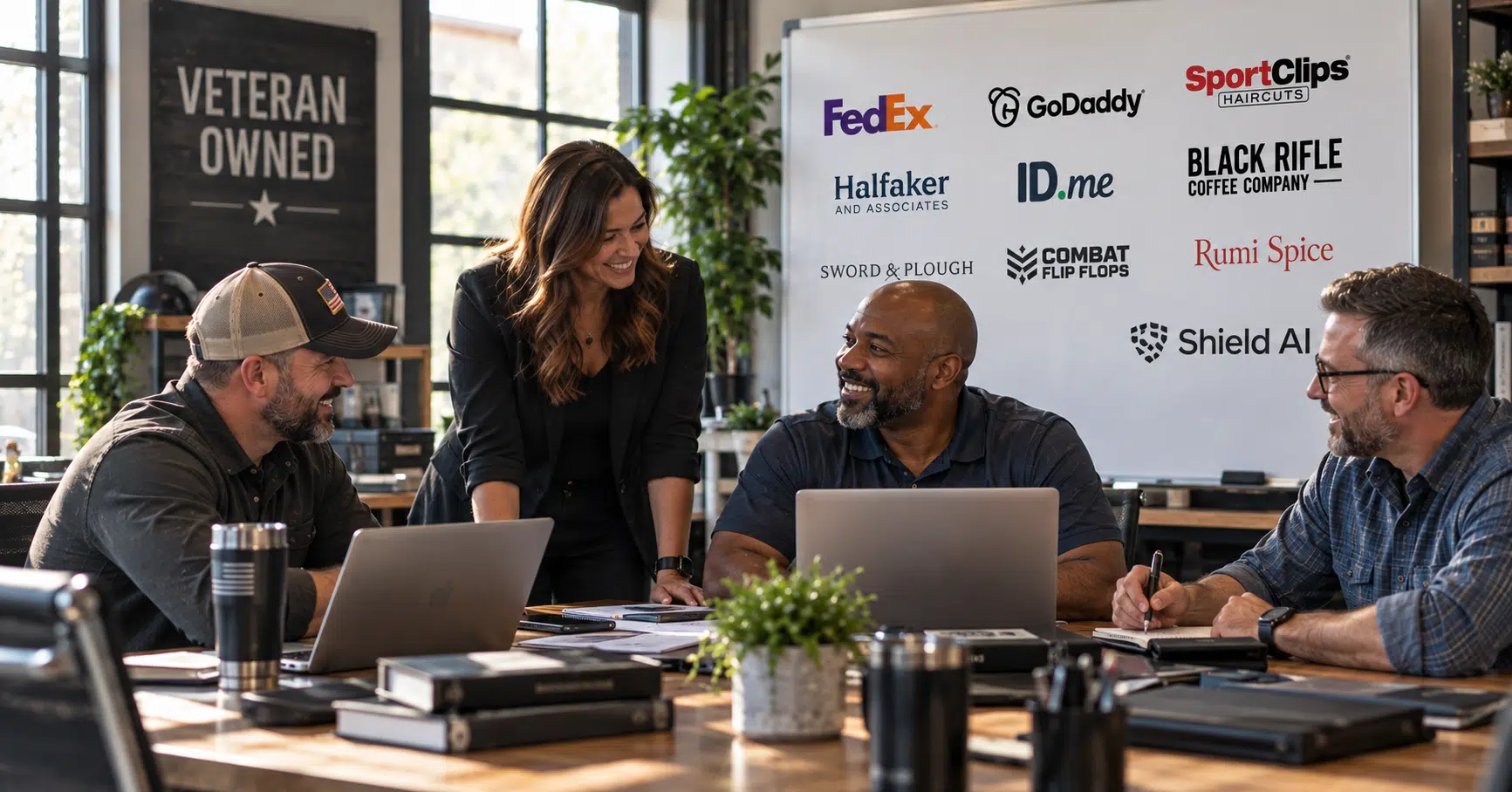
From an Army Ranger who watched Veterans hand over their DD214s to prove military service to a Navy SEAL who saw how autonomous technology could protect troops, here are 10 Veteran entrepreneurs who turned lessons from military service into successful businesses.
1. Frederick W. Smith — FedEx
Military service: U.S. Marine Corps
Business: FedEx
The lesson: Operations matter just as much as ideas.
Before FedEx became a company capable of moving packages around the world, Frederick W. Smith spent four years in the Marine Corps.
And they weren’t four quiet years.
Smith served two tours in Vietnam as a rifle platoon leader, company commander and aerial observer/tactical air controller. He left the Marine Corps in 1970 as a captain after earning decorations that included the Silver Star, Bronze Star and two Purple Hearts.
The original idea behind FedEx actually predated Smith’s military service. While studying economics at Yale, he developed the concept of an integrated air-to-ground delivery system.
Military service, however, gave him another kind of education.
Smith would later joke that he received his “business degree” from the Marine Corps. After leaving the service, he launched the original Federal Express air-ground network. Operations began in 1973.
What followed is one of the biggest entrepreneurial success stories in American business.
FedEx says the company Smith founded grew into an $87.7 billion global enterprise serving more than 220 countries and territories. Smith died in June 2025 at age 80.
What Veterans can take from his story
The military connection here isn’t that Smith dreamed up FedEx while sitting in Vietnam. He didn’t.
It’s that military service reinforced skills that matter enormously when an idea becomes an operation: logistics, leadership, execution, accountability and coordinating people and equipment when failure has consequences.
A good idea can get a company started.
Building a system that can execute that idea thousands—or millions—of times is something else entirely.
2. Bob Parsons — GoDaddy
Military service: U.S. Marine Corps
Business: GoDaddy, Parsons Technology and later ventures
The lesson: Your first career doesn’t have to predict your next one.
Bob Parsons did not leave the Marines with an obvious résumé for becoming a technology entrepreneur.
He had served as an 0311 rifleman in Vietnam and received the Purple Heart, Combat Action Ribbon and Vietnamese Cross of Gallantry. Afterward, he used the GI Bill to attend the University of Baltimore.
Then his career took a turn.
Parsons became a CPA and taught himself how to program microcomputers.
Eventually he invested $40,000 into Parsons Technology, a financial software business he started himself. He sold that company for $64 million in 1994.
Three years later, he started GoDaddy.
According to Parsons’ official biography, GoDaddy eventually became the world’s largest domain-name registrar, and Parsons sold a 71% stake in the company in 2011 for $2.3 billion. He later went on to build other businesses, including golf equipment company PXG.
Parsons has publicly credited the Marine Corps with having a major influence on his later accomplishments.
What Veterans can take from his story
There is a useful transition lesson buried in Parsons’ career.
Your MOS does not determine the boundaries of your civilian career.
A Marine rifleman became an accountant. The accountant taught himself computer programming. The programmer became an entrepreneur.
Veterans sometimes approach transition by asking, “What civilian job matches what I did in the military?”
That’s one question.
Another is: What can I learn next?
Parsons’ career is a pretty good argument for asking both.
3. Gordon Logan — Sport Clips
Military service: U.S. Air Force
Business: Sport Clips Haircuts
The lesson: Build something that can work without reinventing it every time.
Gordon Logan’s route from the Air Force to entrepreneurship wasn’t immediate either.
Before launching Sport Clips, Logan served as an aircraft commander in the Air Force, worked as a financial consultant and gained experience owning salons in Texas.
Then he noticed an opening in the market.
Hair salons existed everywhere, but Logan believed men and boys were underserved by the existing salon experience.
So in 1993 he opened the first Sport Clips in Austin, Texas.
The concept was simple: haircuts aimed specifically at men and boys in a sports-themed environment.
The interesting part is what happened next.
Instead of treating one successful location as the finish line, Sport Clips developed a repeatable franchise model. The company expanded first into Houston and Dallas and even used Southwest Airlines routes as part of its early expansion strategy to control travel costs as the system grew. By 2007, Sport Clips had already opened its 400th and 500th stores.
Logan also kept a connection to the military community. Sport Clips’ Help A Hero scholarship program with the VFW has generated more than $16 million for education and career training for service members and Veterans since 2013.
What Veterans can take from his story
A business that depends entirely on the founder doing everything isn’t very scalable.
Processes are.
Veterans coming from aviation, maintenance, logistics, operations and other process-heavy military fields may understand this better than they realize.
You establish a standard. You train people to the standard. You measure performance. You improve the process.
That mindset can translate extremely well to franchising and other businesses built around repeatable operations.
4. Dawn Halfaker — Halfaker and Associates
Military service: U.S. Army
Business: Halfaker and Associates
The lesson: Expertise can become the business.
Not every entrepreneur has to invent a new consumer product.
Sometimes the valuable thing you’re selling is what you know.
Dawn Halfaker built her post-military career around that idea.
Halfaker served as a military police officer in the Army and was severely wounded during a deployment to Iraq. After transitioning out of the military, she ultimately founded Halfaker and Associates in 2006.
The company grew into a technology and professional services business serving government customers, including organizations connected to national security, healthcare and the federal government.
In 2021, SAIC acquired Halfaker and Associates. SAIC’s final SEC reporting listed the purchase price at approximately $228 million, net of cash acquired.
That is a long way from assuming entrepreneurship requires inventing the next app or opening a storefront.
What Veterans can take from her story
Think about what you understand because of your military career that an outsider might take years to learn.
Maybe it’s procurement.
Cybersecurity.
Healthcare systems.
Aviation.
Logistics.
Training.
Federal contracting.
Supply chains.
Maintenance.
Working inside the Department of Defense.
That knowledge has value.
One of the biggest mistakes transitioning service members make is focusing exclusively on their job title instead of the problems they learned how to solve.
Your experience itself can be intellectual capital.
5. Blake Hall — ID.me
Military service: U.S. Army Ranger
Business: ID.me
The lesson: Pay attention to the problems that annoy you.
This may be the clearest military-to-business connection on this list.
Blake Hall came from a military family and served as an Army Ranger.
Then he noticed something that didn’t make much sense.
A Veteran trying to receive a military discount was showing a store employee a DD214.
Think about how much information is on that document.
The Veteran was revealing far more personal information than a retailer actually needed simply to answer one question:
Did this person serve?
Hall saw the privacy problem immediately.
That experience helped inspire what became ID.me.
The company initially focused on making it easier and safer for members of the military community to verify their affiliation. From there, the concept expanded to other groups and eventually into broader digital identity verification for government, healthcare, financial services and private companies.
By 2022, ID.me reported that roughly 12.5 million military-community users had used its system more than 250 million times to access services and benefits.
What Veterans can take from his story
Potential business ideas aren’t always revolutionary inventions.
Sometimes they’re aggravating problems everybody has simply accepted.
Veterans encounter plenty of them:
Why is this process so complicated?
Why are we still doing this manually?
Why can’t these two systems communicate?
Why does getting this benefit require six steps?
Why is there no good product for this particular situation?
Most people complain and move on.
An entrepreneur asks whether the problem can be fixed—and whether enough other people have the same problem to build a business around the solution.
6. Evan Hafer — Black Rifle Coffee Company
Military service: U.S. Army
Business: Black Rifle Coffee Company
The lesson: Knowing exactly who you’re building for can be an advantage.
Evan Hafer didn’t discover coffee after leaving the Army.
He was already obsessed with it.
Hafer served 20 years in the Army, including 15 years in Special Forces as a Green Beret. During deployments to Iraq and Afghanistan, he continued refining his coffee-roasting skills.
In 2014, he founded Black Rifle Coffee Company.
Instead of trying to make a coffee brand for everybody, Hafer built one with a very specific identity and audience, particularly within the Veteran and military communities.
That identity became a major part of the company’s growth.
Black Rifle Coffee Company eventually expanded well beyond bags of coffee sold online into retail products, cafés, media and a publicly traded company. Hafer served as CEO from the company’s founding through December 2023 and now serves as executive chairman.
What Veterans can take from his story
You don’t necessarily need everybody to understand your business.
You need the right people to understand it.
Veterans often have firsthand knowledge of communities that outsiders don’t fully understand: military families, tactical professionals, federal employees, maintainers, outdoor enthusiasts, overseas communities and countless others.
That doesn’t guarantee a successful business.
But understanding a customer better than competitors do can be a serious advantage.
7. Emily Núñez Cavness — Sword & Plough
Military service: U.S. Army
Business: Sword & Plough
The lesson: Look at the resources around you differently.
Emily Núñez Cavness saw something most people probably wouldn’t look at twice.
Military surplus.
To her, it represented raw material.
Núñez Cavness served in the Army, including with 10th Special Forces Group, and deployed to Afghanistan. She and her sister Betsy eventually co-founded Sword & Plough, a company that repurposes military surplus and other durable materials into bags and accessories.
The military connection wasn’t added afterward as a marketing story.
It was baked into the concept.
The company has incorporated Veterans into different parts of its business while creating consumer products from material associated with military service.
What Veterans can take from her story
Entrepreneurship is partly about learning to see value where other people see something ordinary.
Equipment.
Waste.
An inefficient process.
A niche community.
A skill everyone in your unit considered normal.
A product that’s difficult to find.
A service military families constantly need.
Your military experience may have exposed you to materials, systems, communities and problems most Americans rarely encounter.
The question is whether you’re looking at any of them differently now that you’re on the civilian side.
8. Matthew “Griff” Griffin — Combat Flip Flops
Military service: U.S. Army Ranger
Business: Combat Flip Flops
The lesson: Deployment can change how you see a market.
Matthew “Griff” Griffin graduated from West Point and served in the 75th Ranger Regiment as a rifle company fire support officer.
His military career included three tours in Afghanistan and one in Iraq.
After leaving active military service, Griffin continued working in industries connected to difficult and conflict-affected environments.
Then came Combat Flip Flops.
Griffin co-founded the company in Kabul, Afghanistan. The business grew around an unusual premise: use commerce and employment to create opportunity in places Americans often knew primarily because of war.
Combat Flip Flops developed products including footwear and accessories while building a brand closely connected to Griffin’s experiences overseas.
What Veterans can take from his story
Deployment gives service members an unusual window into the world.
You don’t experience another country the same way a tourist does.
You see infrastructure, transportation, local businesses, supply chains, security problems and communities operating under circumstances most Americans never encounter firsthand.
That doesn’t automatically produce a business idea.
But it can produce perspective.
And perspective is valuable because entrepreneurs often succeed by seeing an opportunity that isn’t obvious to everyone else.
9. Keith Alaniz and the Veteran Founders of Rumi Spice
Military service: U.S. Army Veterans
Business: Rumi Spice
The lesson: Sometimes the business opportunity is hiding inside a bigger problem.
Keith Alaniz came home from Afghanistan thinking about something bigger than spices.
He was thinking about economic stability.
During his military service there, Alaniz became convinced that a sustainable economy was important to Afghanistan’s long-term future.
Then he met a farmer with a very specific problem.
The farmer had high-quality saffron.
What he didn’t have was reliable access to buyers.
Alaniz contacted his friend and future co-founder Kim Jung. They purchased the farmer’s saffron, brought it to the United States and introduced it to chefs.
That helped set the foundation for Rumi Spice, a Veteran-founded company connecting Afghan agricultural products with international customers.
It’s a good example of entrepreneurship starting with a question that sounds almost ridiculously straightforward:
There is a good product here. Why can’t it reach the people willing to buy it?
What Veterans can take from his story
Some entrepreneurs create new products.
Others create connections that didn’t exist before.
Producer to buyer.
Expert to customer.
Technology to user.
Worker to employer.
The opportunity isn’t always inventing something.
Sometimes the opportunity is building the missing bridge.
10. Brandon Tseng — Shield AI
Military service: U.S. Navy SEAL and Surface Warfare Officer
Business: Shield AI
The lesson: Build the tool you wish you’d had.
Brandon Tseng spent seven years in the Navy as a SEAL and Surface Warfare Officer, including deployments to Afghanistan, the Pacific and the Arabian Gulf.
During that service, he encountered situations where autonomous systems could potentially have reduced risk to service members.
That experience helped produce the question behind Shield AI:
What could the military look like if intelligent autonomous systems could perform some of the dangerous work currently requiring people?
In 2015, Tseng co-founded Shield AI with Ryan Tseng and Andrew Reiter.
The company’s mission is unusually direct: protect service members and civilians with intelligent systems. Shield AI says Brandon Tseng’s firsthand experiences during military deployments helped drive the company’s founding.
It has since grown into a major defense technology company developing AI pilots and autonomous aircraft systems. Shield AI says it reached a $5 billion valuation under co-founder Ryan Tseng’s tenure as CEO and grew to approximately 1,000 employees.
In 2026, the company was also selected as one of the companies eligible to compete for up to $800 million in U.S. Navy task orders for intelligence, surveillance and reconnaissance services. That figure represents the overall contract vehicle—not a guaranteed $800 million award to Shield AI.
What Veterans can take from his story
There’s a question worth asking after military service:
What did you wish existed when you were doing your job?
Better software?
Better equipment?
Better training?
A safer process?
A faster way to move information?
A product designed by someone who actually understood the environment?
Most Veterans aren’t going to launch a multibillion-dollar defense technology company.
That’s not the point.
The point is that firsthand experience can reveal problems outsiders don’t even know exist.
And understanding the problem is often the first step toward building something valuable.
What These Veteran Entrepreneurs Actually Have in Common
Put these 10 stories next to each other and something becomes clear.
There isn’t one Veteran entrepreneur personality.
One built a global logistics company. Another built a hair-care franchise. Others built software, coffee, bags, spices, footwear and autonomous aircraft.
Their military backgrounds are different too.
Marines. Rangers. Special Forces. Air Force. Navy SEALs. Officers and enlisted service members.
But a few patterns show up repeatedly.
They noticed problems
Blake Hall saw Veterans unnecessarily exposing information from their DD214s.
Keith Alaniz met Afghan farmers who had valuable products but limited access to markets.
Brandon Tseng saw situations where autonomous technology could potentially reduce risk to service members.
Entrepreneurs tend to notice friction.
Veterans have spent years surrounded by it.
They understood systems
The military teaches you pretty quickly that accomplishing something once isn’t the same as building a process that works repeatedly.
FedEx and Sport Clips couldn’t have reached their scale without systems.
Neither could ID.me.
You don’t have to call that experience “entrepreneurial” for it to be useful in entrepreneurship.
They knew a community other people didn’t
Evan Hafer understood the Veteran market because he was part of it.
Emily Núñez Cavness understood military materials and culture.
Several founders on this list understood military or government customers from firsthand experience.
Knowing exactly who you’re serving—and what that group actually needs—is valuable.
They didn’t stay trapped inside their MOS
This might be the biggest lesson of all.
Bob Parsons was a Marine rifleman.
That didn’t stop him from becoming an accountant, programmer and technology entrepreneur.
Military experience is part of your professional background.
It doesn’t have to become a fence around it.
Thinking About Starting Your Own Business After the Military?
You don’t need to build the next FedEx.
And you don’t need a multimillion-dollar idea.
Start smaller.
What problem do people repeatedly ask you to solve?
What did your military experience teach you that civilians in your industry might not know?
What process drives you crazy because you know there’s a better way?
What product did you constantly wish existed?
What community do you understand unusually well?
Those questions may lead nowhere.
Or one of them may lead to a business.
Either way, they’re more useful than sitting around waiting for the mythical “perfect business idea” to arrive.
The Veterans on this list built radically different companies, in different industries, during different eras.
The common thread wasn’t that the military gave them a company.
It gave them experiences.
They figured out what to do with them next.
Ready to Explore Veteran Entrepreneurship?
You don’t have to figure out the business side of life after the military by yourself.
Vetrepreneur® is built specifically for Veterans interested in entrepreneurship, business ownership and franchising. You’ll find Veteran business stories, practical advice, franchise opportunities and resources designed to help you figure out whether owning a business makes sense for your next chapter.
Whether you’ve already got an idea scribbled in a notebook or you’re simply wondering what business ownership might look like after the military, explore Vetrepreneur® and see where other Veterans are taking their experience next.