
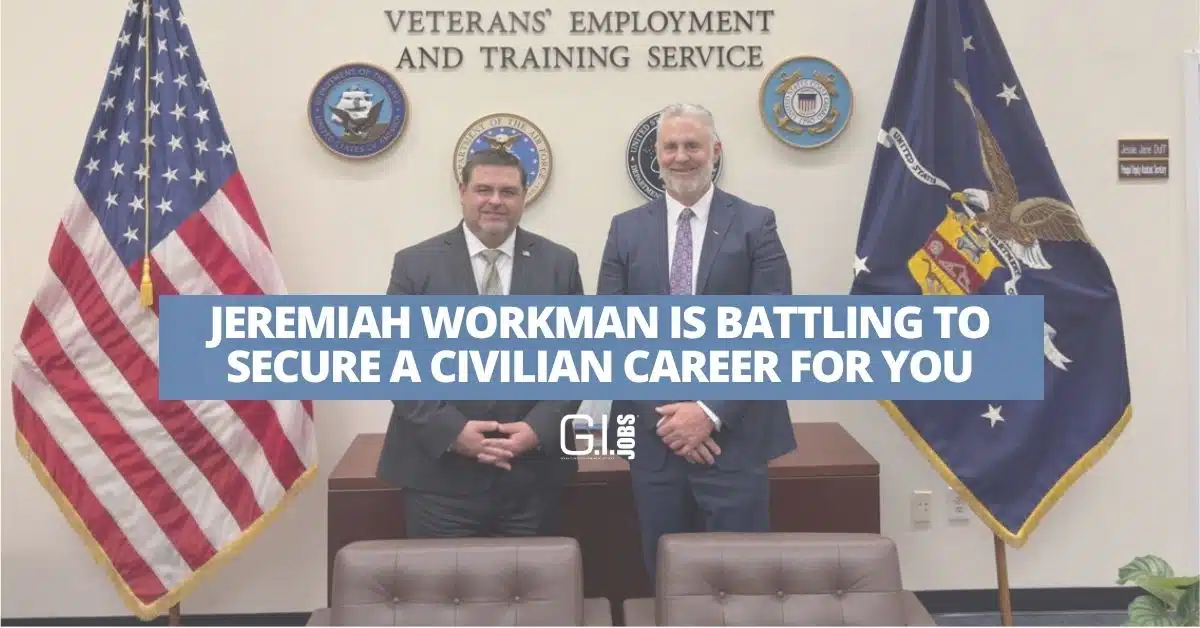

Jeremiah Workman survived Fallujah. Now, he’s battling
to secure a meaningful civilian career for you.
As a teenager growing up in the farming town of Richwood, Ohio, Jeremiah Workman remembers his reaction when a Marine Corps recruiter walked into his high school cafeteria.
“I just remember being really impressed by the way they carried themselves, the way they looked, even the way they talked,” Workman said. “And I knew then that the Marine Corps was going to be my route.”
At the time, Workman was a sports-loving kid from a town of about 2,000 people, part of a graduating class of only 83 students. Like many boys growing up in small-town America, he spent his childhood wearing his father’s camouflage uniforms and running through the woods pretending to be a soldier.
But the Marine Corps became more than a childhood fascination. It became his identity.
Workman enlisted at 17 through the delayed entry program and arrived at Parris Island on Aug. 19, 2001. Less than a month later, while standing in line at the recruit barbershop, he heard yelling that America was under attack.
“As a recruit, you’re so shielded away from everything,” he said. “I thought Parris Island was under attack. I didn’t know the scope of it.”
The full reality of Sept. 11 did not sink in until he graduated from boot camp and returned home for post-training leave.
“I knew I would probably have an opportunity to go overseas and put all my training to good use,” he said.
Like countless service members of his generation, Workman entered adulthood during wartime. He would eventually deploy to Iraq and participate in some of the fiercest urban combat of the war.
Today, more than two decades later, Workman is engaged in a different kind of mission.
Confirmed on Dec. 18, 2025, as the Assistant Secretary for the U.S. Department of Labor’s Veterans’ Employment and Training Service (DOL VETS), Workman now oversees programs designed to help transitioning service members, veterans and military spouses build meaningful civilian careers.
It is a mission he takes personally.
Lessons Forged in Combat
Workman was only 20 years old when he led Marines in combat during the Second Battle of Fallujah in 2004.
A squad leader at the time, he and his team entered a house and walked into an ambush.
“There were probably 20 to 25 insurgents inside the house, and they were also jumping from rooftop to rooftop to resupply the house,” he said.
What followed was a brutal, three-hour firefight fought at close range.
“Everybody was wounded in the house,” Workman said. “Unfortunately, we lost three Marines that day.”
Workman’s actions during the battle earned him the Navy Cross, the nation’s second-highest military decoration for valor. But when he talks about that day, he quickly shifts attention away from himself.
“I would give that Navy Cross back for those Marines to have their lives back,” he said. “What it’s really done for me is it’s given me a license to tell their story and keep their memory alive.”
The experience changed him permanently.
“I wasn’t old enough to drink alcohol, but I was old enough to go overseas and lead Marines in combat,” he said. “I grew up really quick.”
What he experienced in combat shaped the way he approached life after the military.
“Those experiences and hardships made me a better person,” he said. “They made me a stronger person, and they allowed me to go on to be successful not only in my career, but more importantly, to be a good husband and a good father.”
Training Marines for War
After returning from Iraq, Workman became a Marine Corps drill instructor.
Unlike many drill instructors from earlier generations, Workman and many of his peers had recent combat experience. They understood exactly where newly trained Marines were likely headed.
“I went straight from Fallujah to DI school,” he said. “I knew what I needed to teach these recruits to keep them alive because I knew where they were going.”
That perspective shaped the way he approached training.
“I think having that generation of Marines coming back from combat was good for recruits,” he said. “They were being trained by people who had danced with the devil overseas.”
For Workman, the mission was never simply about producing Marines capable of graduating boot camp. It was about preparing them for the realities of combat and ensuring they returned home alive.
That same sense of responsibility now drives his work at VETS.
A Difficult Transition
Despite his decorated military career, Workman’s own transition out of the Marine Corps was far from easy.
After years of service, he was medically retired.
“I felt like my livelihood was being taken away from me,” he said. “I loved being a Marine. I loved being with the Marines.”
Being told by a Navy doctor that he was no longer fit for service was devastating.
For many veterans, the transition to civilian life involves more than simply finding a job. It can mean losing the structure, identity and camaraderie that defined nearly every aspect of life.
“When you get out, that identity is stripped away,” Workman said. “You’re no longer around those people that you trust and respect. One day, it’s gone, and you’re back in small-town USA trying to blend in.”
Workman credits mentors, case managers and support networks for helping him successfully navigate that difficult period.
“By the grace of God and by wonderful people out there, I had a team around me that ensured I landed on my feet,” he said.
That support system helped shape the philosophy he brings to his current role.
“I don’t get spooked by a lot of things. There’s not many things that scare me. But the one thing that does scare me is the thought of a veteran falling through the cracks. That’s what keeps me up at night.”
Finding His Purpose
Workman’s first civilian job was with the Marine Corps Wounded Warrior Regiment at Quantico, Va.
The position allowed him to continue serving Marines and sailors facing some of the toughest challenges imaginable.
“I was on what they called a tiger team,” he said. “I would deploy all over the country to the worst of the worst situations.”
Some of what he encountered left a lasting impression.
“The living conditions of some of our veterans – it was sad,” he said. “But it made the fire burn even more for me. There’s more we can do.”
He later transitioned to the Department of Veterans Affairs and has spent much of his adult life working in service to veterans.
“It’s what motivates me and why I get out of bed in the morning,” he said.
That passion is now central to the work of VETS, the Department of Labor agency tasked with helping veterans and military spouses prepare for civilian employment.
Workman emphasizes that successful transition starts early.
“We are laser-focused on getting it right up front,” he said.
Among the agency’s priorities is the Transition Assistance Program and the Employment Navigator and Partnership Program (ENPP), which provides individualized counseling and support to separating service members.
“We’re having unbelievable results with that,” Workman said, noting the program has expanded to dozens of military installations worldwide.
The goal, he said, is not simply employment. It is meaningful employment.
“We want veterans to have jobs where they can buy a house, wake up in the morning with dignity and respect, and look forward to contributing to society,” he said.
Why Hire Veterans?
Every year, about 200,000 service members leave active duty or transition from the National Guard and Reserve into civilian life.
To Workman, employers who overlook that talent pool are missing an enormous opportunity.
“The government has spent a lot of time and money training these folks up,” he said.
He believes veterans bring qualities that are increasingly difficult to find.
“What you’re going to get with a veteran is somebody that’s disciplined, trainable and shows up on time,” he said.
Workman stressed that technical skills can often be taught more easily than intangible skills like character, accountability and resilience.
“Veterans bring a different type of work ethic,” he said. “They’re going to add value to your operation regardless of what you bring them in to do.”
For employers wondering how to thank veterans for their service, Workman offers a straightforward answer.
“If you want to thank a veteran, hire a veteran.”
Getting the Transition Right
Workman understands that transition is one of the most vulnerable periods in a veteran’s life.
“This is the one opportunity we have to get this right,” he said.
He believes successful employment outcomes can influence nearly every other aspect of a veteran’s well-being.
“If we get it right at the front end, the benefits and services on the back end become less necessary,” he said.
His long-term vision is ambitious: fewer homeless veterans, fewer veterans struggling to find direction and more veterans thriving in meaningful careers.
“It starts with wrapping our arms around these folks early and giving them the tools and resources necessary to make a successful transition,” he said.
That mission resonates because Workman has lived it himself.
He understands the challenge of losing a military identity. He understands the uncertainty many veterans feel when they remove the uniform for the final time.
But he also understands what is possible when veterans receive the right support.
For transitioning service members wondering what comes next, Workman’s message is clear: The skills developed in uniform still matter. Leadership matters. Discipline matters. Purpose matters.
And with the right guidance and opportunities, the next chapter can be just as meaningful as the last.
As Workman sees it, helping veterans build that future is not simply a government program or a policy objective.
It is a responsibility.
“We have the best job on the planet,” he said of the work being done at DOL VETS. “We get to come to work every day and make sure service members, spouses and veterans can successfully transition and find gainful employment.”
For a Marine who once led troops through the streets of Fallujah, the mission has changed.
The commitment to fellow veterans has not.