
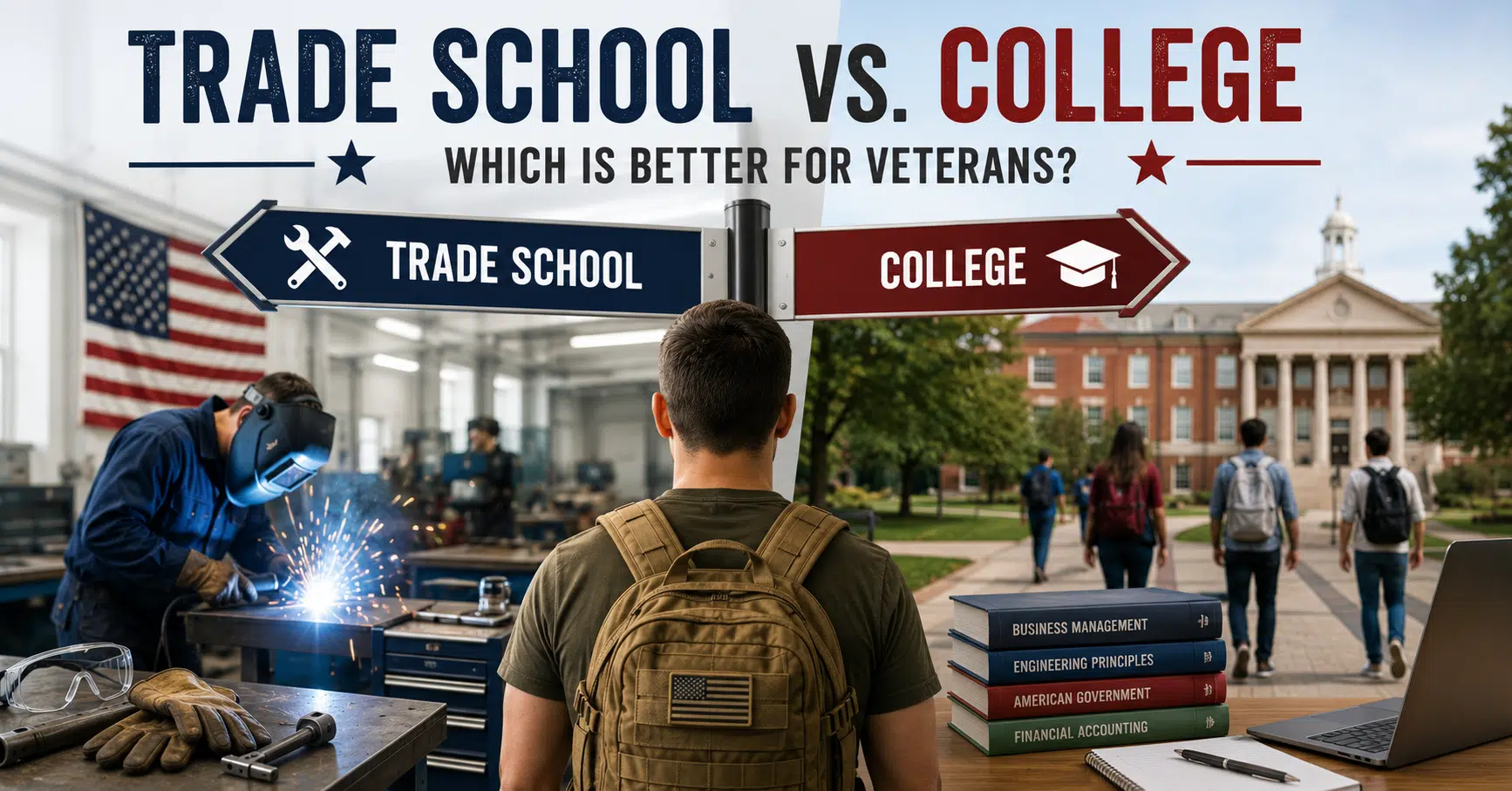
Trade School or College? Let’s Settle This.
Not every Veteran needs a four-year degree—and not every career can be reached through a trade program.
We break down the pros, cons, costs, timelines and GI Bill considerations to help you choose the education path that actually fits your career goals.
Last Updated August 2026: GI Bill rules, payment rates and approved programs can change. Verify current eligibility and program approval with the Department of Veterans Affairs before enrolling.
Use the GI Bill Comparison Tool for help.
Is trade school or college better for Veterans?
Trade school may be better for Veterans seeking specialized, hands-on training and a faster path into certain careers, while college may be better for careers requiring a degree or Veterans seeking broader career options. The best choice depends on the target career, program requirements, cost, time and available GI Bill benefits.
For Veterans leaving the military, choosing what comes next can feel like another major career decision.
Do you go back to school for a bachelor’s degree? Learn a skilled trade? Earn a certification? Go straight into the workforce?
There isn’t one right answer.
For some Veterans, a four-year degree is the best path toward a long-term career. For others, spending four years in a classroom makes little sense when they could complete technical training in a fraction of the time and start earning a paycheck.
And here’s something many Veterans don’t realize: the GI Bill isn’t limited to traditional college.
The Department of Veterans Affairs says GI Bill benefits can be used for certain degree programs as well as specific career and trade training, including programs such as HVAC, truck driving and EMT training.
So the question isn’t simply “Is trade school better than college?”
It’s:
Which education path gives you the skills, credentials and career opportunities that make sense for your next chapter?
Takeaways
- Trade school can provide a faster path into many hands-on careers.
- College can provide broader career options and may be necessary for certain professions.
- Eligible Veterans may be able to use GI Bill benefits for both college and qualifying non-degree training programs.
- The Post-9/11 GI Bill currently covers qualifying non-college-degree programs, subject to applicable benefit limits.
- Your military experience, career goals, financial situation and preferred work environment should all factor into the decision.
- You don’t necessarily have to choose one path forever. A trade credential and a college degree can complement each other over the course of a career.
Trade School vs. College at a Glance
| Trade School | College | |
|---|---|---|
| Typical focus | Specific career or skill | Broad academic or professional education |
| Time to complete | Often months to two years | Typically two to four+ years |
| Learning style | Hands-on and technical | Classroom, academic and/or practical |
| Career path | More specialized | Often broader |
| Common careers | HVAC, welding, electrical, CDL, technical fields | Business, engineering, healthcare, education, technology |
| GI Bill eligibility | Some qualifying programs | Many qualifying institutions/programs |
| Best for | Veterans who want targeted career training | Veterans pursuing careers requiring or benefiting from degrees |
The important word in that table is “some.”
Don’t assume every school or program qualifies for GI Bill benefits. VA specifically recommends using its GI Bill Comparison Tool to verify approved schools and programs and compare available benefits.
What Is Trade School?
Trade schools—also called vocational or technical schools—focus on preparing students for a specific occupation or industry.
Instead of taking general education courses for several years, students typically spend more of their time learning the skills directly related to the job they want.
Programs can include fields such as:
- HVAC
- Welding
- Electrical work
- Plumbing
- Automotive technology
- Aviation
- Commercial driving
- Industrial maintenance
- Medical assisting
- Construction
- Manufacturing
- Emergency medical services
For a Veteran who already knows, “I want to become an electrician,” a focused technical program may make more sense than pursuing a general degree.
What Is College?
College generally offers a broader educational experience.
Depending on the institution and program, Veterans can pursue:
- Associate degrees
- Bachelor’s degrees
- Graduate degrees
- Professional degrees
- Certificates
College may be the better route for careers that require a specific degree or for someone who wants the flexibility to move between multiple professional fields.
For example, careers in fields such as teaching, engineering, accounting, nursing and many professional occupations may require specific degrees, licenses or combinations of education and experience.
Which Is Faster: Trade School or College?
This is one of the biggest differences.
Many trade programs are designed to get students job-ready relatively quickly.
A Veteran might spend months or a couple of years developing the technical skills needed for a particular occupation rather than spending four years completing a bachelor’s degree.
That doesn’t mean every trade program is short or every college program takes four years.
Program length varies considerably.
The better question is:
How long will it take me to become qualified for the job I actually want?
If your target occupation requires a four-year degree, trade school isn’t necessarily a shortcut.
But if your goal is a career where a technical credential or apprenticeship is the standard entry point, a traditional bachelor’s degree could add time and expense without providing a meaningful advantage.
Which Costs More?
There’s no universal answer.
A four-year college can involve tuition, fees, books, transportation and living expenses.
Trade programs can be less expensive overall because they may take less time, but tuition varies widely depending on the program and institution.
And Veterans have another factor to consider:
How much of your education benefit will each option consume?
Under the current Post-9/11 GI Bill rates for August 1, 2026 through July 31, 2027, VA lists qualifying non-college-degree programs alongside institutions of higher learning as eligible categories for tuition and fee benefits, subject to the applicable rules and limits.
That makes it especially important to compare the total cost and benefit usage, rather than simply looking at the sticker price.
Can You Use the GI Bill for Trade School?
Yes, certain qualifying trade and vocational programs can be covered by GI Bill benefits.
VA specifically lists career and trade training such as HVAC repair, truck driving and EMT programs among examples of training for which GI Bill benefits may be available.
For the 2026–27 academic year, VA says the Post-9/11 GI Bill can pay qualifying net tuition and mandatory fees for non-college-degree programs up to the applicable annual maximum. Eligible students may also receive other benefits depending on the program, enrollment and eligibility.
But don’t make your decision based on a school’s claim that it “accepts the GI Bill.”
Verify the specific program.
Use the VA’s GI Bill Comparison Tool to determine whether the program is approved and compare benefits before enrolling.
What About GI Bill Housing Benefits?
This is another area where Veterans should compare programs carefully.
Eligible Post-9/11 GI Bill users may receive a monthly housing allowance while attending qualifying programs, but eligibility and payment amounts depend on factors such as enrollment, eligibility percentage and the type and location of training.
VA’s current rules also distinguish between different types of training. For example, certain students in correspondence or flight training aren’t eligible for MHA, while eligible students in qualifying in-person programs may receive housing payments.
Bottom line: Don’t compare schools based solely on tuition. Compare the entire benefits package.
Which Offers Better Job Opportunities?
This depends almost entirely on the career.
A Veteran pursuing cybersecurity may benefit from a degree, industry certifications or both.
Someone interested in welding may have no reason to spend four years earning a bachelor’s degree before entering the workforce.
Someone pursuing engineering will likely need a degree.
Someone interested in becoming an HVAC technician may benefit more from technical training and hands-on experience.
The best education path is the one that matches the actual requirements of the job you’re targeting.
Trade School May Be Better If You…
Trade school could be a strong fit if:
You Want to Start Working Quickly
If you’re ready to get into the workforce and begin earning, a shorter technical program may be attractive.
You Prefer Hands-On Learning
Some people would rather work with tools, equipment, machinery or patients than sit in a lecture hall.
Your military experience may have already taught you that you learn best by doing.
You Know What Career You Want
If you’ve already chosen your occupation, specialized training can make sense.
You Want a Skilled Trade
Construction, manufacturing, transportation, utilities and maintenance all offer career paths where technical skills can be more important than having a four-year degree.
College May Be Better If You…
College may make more sense if:
Your Career Requires a Degree
Some professions simply require formal degrees.
You Want More Career Flexibility
A bachelor’s degree can provide a broader educational foundation that may allow you to move between industries or pursue graduate education later.
You’re Interested in Management
A degree can sometimes become more valuable as you move into management, leadership or specialized professional roles.
You Want to Build a Long-Term Academic Path
If you already know that graduate school or professional education is part of your plan, starting with a degree may be the logical choice.
What About Community College?
Don’t overlook the middle ground.
A community college can combine some of the advantages of both paths.
You may be able to:
- Complete an associate degree
- Earn technical certifications
- Learn skilled trades
- Complete general education courses
- Transfer to a four-year university
- Pursue career-specific training
For some Veterans, community college provides the best combination of cost, flexibility and career preparation.
Don’t Choose an Education Path Before Choosing a Career Path
This might be the most important advice in the entire article.
Don’t start with:
“Should I go to college?”
Start with:
“What do I want to be doing five years from now?”
Then work backward.
Step 1: Identify the career.
What job do you actually want?
Step 2: Research the requirements.
Does that job require:
- A degree?
- A license?
- A certification?
- An apprenticeship?
- Work experience?
Step 3: Find the shortest legitimate path.
Don’t spend four years earning something you don’t need.
But don’t choose a six-month credential if your target career requires a bachelor’s degree.
Step 4: Compare programs.
Look at:
- Cost
- Length
- Graduation rates
- Job placement
- Employer partnerships
- Location
- Schedule
- GI Bill eligibility
Step 5: Calculate the return.
Ask:
“What am I likely to gain from this investment?”
Don’t Waste Your GI Bill Benefits
Your GI Bill is one of the most valuable education benefits you’ve earned.
That doesn’t mean you should use it simply because you have it.
Before enrolling, compare your options.
A Veteran might use benefits to earn a bachelor’s degree.
Another might use them for technical training.
Another might combine a degree with certifications.
Another might pursue an apprenticeship or on-the-job training.
VA’s education programs cover multiple pathways, including degree programs, trade training, licensing and certification exams, apprenticeships and certain high-tech programs.
The smartest choice isn’t necessarily the option that uses the most benefits.
It’s the option that helps you build the career you want.

Choose Trade School If:
You want:
A faster, specialized career path
You enjoy:
Hands-on work
You know:
Exactly what occupation you want
Your career requires:
Technical training, certification or apprenticeship
Choose College If:
You want:
A broader academic foundation
You enjoy:
Academic or theoretical learning
You want:
More flexibility to change professional directions
Your career requires:
A degree or advanced education
What If You Still Can’t Decide?
You don’t have to make the decision alone.
Talk with:
- A career counselor
- A school’s Veterans services office
- Employers in the field you’re considering
- Veterans already working in that career
- A VA-approved education representative
And research actual job postings.
Look at 20–30 jobs you’d want to apply for.
Write down the requirements.
If most say “bachelor’s degree required,” that tells you something.
If most say “certificate, apprenticeship or relevant experience,” that tells you something too.
Let the labor market help make the decision.
The Bottom Line
There is no universal winner in the trade school vs. college debate.
Trade school isn’t “less than” college. College isn’t automatically “better.”
They’re different tools for different career goals.
For one Veteran, the smartest move might be a four-year degree.
For another, it could be an HVAC program, CDL, welding certification or electrical apprenticeship.
And for another, it might be both—a technical credential now followed by a degree later.
The goal isn’t to choose the most impressive education path.
It’s to choose the path that gets you where you want to go.
Before spending your GI Bill benefits, research the career, verify the program’s eligibility, compare costs and understand what employers actually want.
Your next mission doesn’t have to look like everyone else’s.
Frequently Asked Questions
Is trade school better than college for Veterans?
Not necessarily. Trade school may be better for Veterans who want specialized, hands-on training and a faster path into certain careers. College may be better for careers requiring a degree or Veterans seeking a broader academic foundation.
Can Veterans use the GI Bill for trade school?
Yes. Certain qualifying non-college-degree programs can receive GI Bill benefits. VA specifically lists programs such as HVAC, truck driving and EMT training as examples of career training that may qualify. Veterans should verify the specific program using the GI Bill Comparison Tool.
Does the GI Bill pay for vocational training?
It can. Eligible Veterans may use qualifying GI Bill benefits for certain vocational and technical training programs. The amount and type of benefits depend on the program and the Veteran’s eligibility.
Is trade school cheaper than college?
It can be, particularly when a trade program takes significantly less time to complete. But costs vary by school, program and location. Veterans should compare total program costs and available GI Bill benefits rather than assuming one option is automatically cheaper.
What are the best trades for Veterans?
Potential career paths include HVAC, electrical work, welding, plumbing, automotive technology, construction, manufacturing, aviation and transportation. The best trade depends on your interests, transferable military skills, local demand and long-term career goals.
Can I go to trade school and college?
Absolutely. Education doesn’t have to be an either-or decision. A Veteran might earn a technical credential first, enter the workforce and later pursue a college degree—or combine technical training and college education as part of a longer career plan.
Related G.I. Jobs Articles
Is an Online Degree Worth It for Veterans This Year?
Yellow Ribbon vs. Post-9/11 GI Bill: Understanding the Difference
7 GI Bill Benefits Many Veterans Don’t Realize They’re Eligible For
12 Certifications That Can Help Veterans Land a Better Job Faster