Quality Assurance Expert at CSX Transportation
Former Marine helicopter mechanic ensures CSX trains travel smoothly
by Warren Duffie
Scott Mahanes is a stickler for details since in his military and civilian profession negligence could result in serious injury or even death. As a Marine, he was a helicopter mechanic and later a supervisor in charge of training and new mechanics.
Today, as a quality assurance expert for CSX Transportation, Mahanes ensures the railroad giant’s tracks are laid down, repaired, or removed properly.
“In the Marine Corps, there is such a high standard of excellence — you don’t accept anything less,” says Mahanes, who still serves as a reservist. “That has really helped me at CSX. You don’t take chances with quality. If you do, helicopters crash and trains derail.”
Supporting the Military’s Mission
Mahanes’ job is demanding, and he’s usually on the road five days a week. His territory encompasses hundreds of miles of tracks on the East Coast.
So how do Mahanes and his colleagues maintain track quality? Hours of watching. They closely scrutinize the laying of rail ties, the filling of gravel between each tie, the laying of track, and the pounding and pulling of spikes – all performed by workers in powerful machinery.
The master sergeant also makes sure equipment is in good repair, sees that spare parts are available, and works with unions to ensure that workers get their hours.
“My military experience helps in two ways,” Mahanes says. “Management and technical skills. As a Marine, I worked with diverse people and learned to adapt to new situations. That opened my mind to getting the best out of the people I supervised. On the technical side, I understand the value of being meticulous and standard-oriented. Although I worked with aircraft, there is much direct crossover to railroads.”
On the Job
Based in Jacksonville, Fla., CSX Transportation operates the largest railroad in the eastern United States — with a 22,000-mile rail network linking commercial markets in 23 states, the District of Columbia, and two Canadian provinces. The company has 32,000 employees, maintains a fleet of 3,700 locomotives and nearly 105,000 freight cars, and transports an average of 20,000 carloads each day.
A key to the success of the $8.6 billion company is its employees, particularly veterans. In fact, Mahanes describes CSX with one word: patriotic.
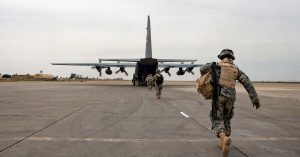
From July 2004 to July 2006, Mahanes’ Reserve unit was activated and stationed in Al Asad, Iraq, where he was a maintenance control chief for CH-46 Echo helicopters. During those two years, CSX paid the difference between Mahanes’ military and civilian salaries.
“CSX is truly committed to its veteran employees,” he says. “To pay me for two years is exceptional. Most Reserve stints only last a year. So for CSX to go the extra mile for me was very special.”
Military Experience
Mahanes’ love of tinkering began during high school, when he took an automotive course. The Richmond, Va., native took to nuts, bolts, sparkplugs naturally and soon became a certified mechanic — working at a local garage during high school.
“But I knew I didn’t want to fix cars for the rest of my life, and with my maturity level at the time college was out of the question,” Mahanes says. “Then one day, a Marine Corps recruiter approached me and talked about the opportunities available in aviation mechanics. That really appealed to me and sounded like a great future. So I enlisted after I graduated in 1988.”
After basic training at Parris Island and mechanic school in Millington, Tenn., Mahanes was assigned to New River Air Station, which is part of Camp Lejeune, N.C. He stayed there until leaving the service in 1993.
“My wife and I had just had a son,” he says. “I had been deployed a lot before his birth, so I wanted to stay around to be a father. I was on a ship for several months, where I read a lot of books on résumé writing. When I came back to New River, I attended transition assistance classes and began to prepare for my job search.”
The Transition
Mahanes didn’t have to search hard. A couple of months before his separation, his parents saw a newspaper ad by Baker Equipment – which repairs and sells truck equipment – calling for a mechanic/welder. Mahanes applied to Baker as well as CSX. CSX’s recruiter told him he needed more experience with welding and diesel engines – prompting the Marine to go with Baker.
After spending a year and a half installing hydraulic and electrical systems on trucks, Mahanes applied with CSX and was hired as a mechanic. Over the next decade, he rose through the ranks and served in several quality-assurance supervisory positions.
“The hardest part about my transition was the sticker shock of civilian life,” Mahanes says. “As a sergeant in the Marine Corps, I was pulling in $1,700 a month. My first civilian salary with Baker – after taxes and benefits were taken out – was two-thirds of that. I had to work at nights changing tires to make ends meet, and it wasn’t until I was hired by CSX that I could quit my night job.
Mahanes’ Advice
Use your G.I. Bill benefits. “Get as much education as you can. Your income directly correlates to the degrees you earn.”
Connect with service organizations. “I wish there had been organizations like Marines for Life when I got out. They can provide you with so many useful transition tips. Don’t push those resources aside.”
Save your money. “Pay off your credit cards and car before leaving the military. Get rid of as much debt as possible. Civilian life is expensive, and there’s no guarantee you’ll land a job right away. Develop a nest egg.”