Happy Veterans Day
Share
Loading...

Process Systems Engineer at Air Products
Navy veteran Raymon Williams didn’t have to hold his breath to find work after leaving the submarine service.
by Joshua Hudson

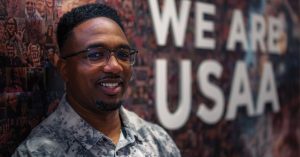
Raymon Williams’ desk is spartan: a laptop, PDA, and some photos of his wife. However, he brought a very full list of skills to his new job at Air Products, in Allentown, Pa.

“I was offered the job two weeks before I got out of the Navy,” said Raymon, a former eight-year Navy veteran. “I really recommend that everyone go to their TAP (Transition Assistance Program) at least once before getting out. They are very helpful.”Sea-to-Air219x292

The Seattle native took every opportunity afforded to him, which led him to the job he has today as a process systems engineer maintaining system schematics and operation procedures for the large air separations plant. Originally he had planned to come into the Navy as a medic.

“My career path completely changed when I decided to join the Navy,” said Williams. “I was almost finished with a degree in psychology at Seattle University. Based my military test results, I was offered the Navy nuclear program. That turned out to be a better fit for me, and very challenging.”

During his eight years in the service, he was able to finish his bachelor’s degree and earn a Master’s of Science while serving as an engineer on nuclear submarines.

“All of that training and education prepared me for my job now,” said Williams. “Everything I did in my military career prepared me for my job today.”

Looking for an Education
Williams joined the Navy in 1998 hoping to earn enough money to finish his bachelor’s degree and gather some practical work experience to become more employable in the medical field. He had been working two jobs to pay for college and take care of his family.

“I almost finished with my coursework for a bachelor’s,” he said, “but I needed to take a break and earn some money. I knew the military would let me earn money, finish my degree and get some good experience.”

He was positive he did not want to make a career out of the service, but understood the advantages of service. During Williams’ career, he learned more than he had anticipated.

“I had no doubt that I would get valuable work, leadership and discipline experience,” said Williams. “One of the best aspects of the service is the training you receive. However, I think that was only half of the reason I was hired. My company hires very qualified talent from universities and recruits from great technical talent pools. They expect the military candidates to have the technical experience, but they also want the experience in leadership, and the ability to communicate and coordinate with diverse groups of people.”

Williams’ experience in the service developed a keen eye for attention to detail and the importance of teamwork. In the military work expectations “are high and every member of the team is answerable for their actions and the consequences” of everyone in their team.

“This is an unrealistic expectation in most of the civilian sector,” said Williams. “In the military we had a culture that demanded we live as a team 24/7 (even after work). That doesn’t exist in the civilian sector.”

That culture of accountability develops employees that can be depended on to take responsibility and be steller performers.

Air Products
Air Products provides unique atmospheric gases, specialty gases, materials, equipment and services to industrial, energy, technology and health care markets worldwide. The description may not sound exciting, but its products are involved in the production of semiconductor computer chips and various health care devices.

William’s position involves interpreting technical drawings and ensuring they adhere to engineering standards. It requires an understanding of chemistry, physics and thermodynamics for various machines and electrical components. It also requires a keen focus on safety for equipment and personnel. While there are distinct differences, this level of work expertise was not that different from his job description in the military.

In the service, Williams was responsible for the proper operation of his submarine’s nuclear power plant. In his current job, he is responsible for the safety of his co-workers and the quality of the products he manages, which could affect entire industries and people’s lives. That is why Air Products needs leaders as well as technicians.

“Service members rarely see how valuable a commodity those military skills are until they are out of the service,” said Williams. “I have become a stronger person, a more strategically assertive person. In the military I was able to progress my personality to become a more marketable person.”

Finding Work
“I submitted countless résumés and had numerous interviews,” said Williams. While he had prepared extensively for his separation from the military, it was still unnerving when he discovered hiring managers were not pounding down his door immediately. He started his job search a year prior to separating. Eventually, his persistence paid off with five job offers within two weeks of his end of service date.

He was impressed with Air Products’ desire to hire talented employees, which included recruiting military as well.

“The company values veteran skills,” said Williams. “They offer various opportunities in prominent and exciting fields, such as electronics, health care, nanotechnology and alternative energy. My program allows me to rotate through different engineering positions with the company. The environment is refreshing, and the work is rewarding.”

It is that challenge and flexibility that really excited Williams to seek a job that almost a decade before would have never been a consideration. It is a job that opened up to him because he took advantage of military opportunity, education and training.

“I work from 7 a.m. to 4 p.m., and occasionally travel to our plants around the country,” said Williams. “Each day is a different challenge. And while the benefits can’t compare to the military, I can say that the pay is much higher.”


Share
More articles from JUNIOR ENLISTED SUCCESS STORIES

Sales Manager at Waste Management, Inc
Service Technician at Johnson Controls
Gas Troubleman Apprentice at Ameren Corp
Engineering Technician at Northrop Grumman
Senior Field Recruiter at Lowes
GET HIRED
Industry:
Select Industries


GOT AN OPINION?

How important is a school's accreditation in pursuit of an education?