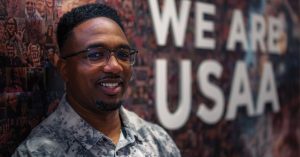
Manager at Southeast Georgia Health System
Former Airman excels with Southeast Georgia Health System.
by Warren Duffie
Tim Bryant was desperate. In 1987, the 22-year-old was weathering the annual economic hurricane in his hometown of Fort Walton Beach, Fla.
Fort Walton Beach, is located on Florida’s “Emerald Coast,” renowned for its pristine beaches, great weather, and friendly locals. According to Bryant, during the summers of the 1980s, local businesses boomed and jobs were plentiful. After Labor Day, however, the economy sank. If you had a fast food or retail job, you were doing well.
Bryant was recently married and the young couple wanted to start a family. But how can you provide a future for your kids when you don’t have “any job skills or education”?
“We worked a bunch of food service and retail jobs – but nothing seemed to get us ahead,” Bryant said. “Then one of my wife’s friends and her husband came over for dinner. He was in the Air Force and we got to talking about the military. The Air Force seemed like it might be a decent way for me to find some direction in life.”
During his military career, Bryant was trained in radiology, diagnostic imaging, and nuclear medicine – skills that helped him land a great civilian job in 2007.
A Master of Motivation
The former master sergeant is currently the manager of radiology and cardio-pulmonary services for the Camden campus of the Southeast Georgia Health System. His location is a 40-bed facility in St. Marys, Ga.
“We’re near Naval Submarine Base Kings Bay,” said Bryant, 42. “The base doesn’t have a hospital, just an out-patient center, so we receive a lot of service members and their families. It’s easy to walk around my hospital and see a lot of uniforms, which is very comforting to a veteran like me.”
Bryant manages the daily operations of the radiology department (consisting of X-ray, cat scans, MRIs, mammography, ultrasound, and nuclear medicine) as well as the cardio-pulmonary lab (consisting of respiratory therapy, echocardiography, the sleep management center, and neuro-diagnostics). His duties encompass planning work schedules, supervising personnel, ensuring all equipment is working properly, and scheduling necessary repair and maintenance.
“The organizational and managerial skills I developed in the Air Force help me every day,” Bryant said. “You have to get to know your people and how to motivate them.
Turning Childhood Wonder into a Career
After completing basic training, Bryant worked as a mail and distribution clerk on Randolph Air Force Base, Texas. After three years of “shipping out packages,” he was bored and wanted a new challenge. So he transitioned into a health care position receiving training in radiology and, later, nuclear medicine.
With a daughter nearing the end of middle school, he wanted to give her the opportunity to stay at one high school for all four years. So he decided to retire from the Air Force after 20 years.
Bryant’s first task involved attending transition classes, calling on former co-workers, and poring through publications such as G.I. Jobs (he especially loved the profiles, résumé tips, and “Dress for Success” section). However, his job search was a frustrating mission thanks to two obstacles: time and distance.
Since Alaska is hours behind many mainland U.S. states, Bryant often rose at 0400 to make calls and schedule interviews: “I must have participated in 23 phone interviews. Toward the end, I was so bored with them that I must have sounded like a horrible employment prospect.”
Traveling from Alaska to many stateside interviews was another challenge. Many of his in-person interviews required many days of travel for an interview that would only take a couple of hours. Fortunately, he found a great position at Southeast Georgia Health System.
So what did his transition experience teach him?
“When interviewing with a company, find out the costs of health and life insurance. These costs may come as a big surprise to you, and you might want to negotiate your salary based on that information. Also consider the tax breaks you’ll no longer receive with BAS, BAH, and COLA.”