Happy Veterans Day
Share
Loading...

Human Resources Supervisor at Fluor Corporation
Soldier finds his civilian niche at Fluor Corporation after a rocky transition.

by Warren Duffie

Rob Wells’ career had bottomed out. The former Army captain was working as a Morgan Stanley financial advisor trainee when the financial crisis of 2008 shook the foundation of the American economy. Wells and many of his fellow trainees were laid off, leaving him with few prospects.rob-wells219x292

Since leaving the military in 2006, Wells had marched through the corporate battlefield uncertain of purpose. He sold cars for a couple of months before going to Morgan Stanley, but he hated that gig and refused to go back. The combat veteran missed the excitement of his Army career and wanted to do something as meaningful and mission-oriented.

“There was nothing going on, job-wise, in the U.S.,” said Wells, “so I did some research on contracting jobs in Iraq and Afghanistan. The name of Fluor Corporation kept coming up. I contacted them and spoke to a recruiter who was a fellow former Army officer. I sent my 
résumé, went through a couple of interviews and was hired within three weeks. I went to work on a project in Afghanistan, helping to 
ensure that aircraft and helicopters got where they needed to go.”

On the Job
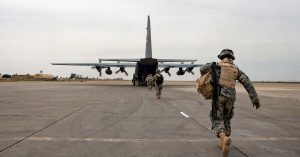
Fluor Corporation is one of the world’s largest publicly owned engineering, procurement, construction, maintenance and project management companies. One of the company’s most prominent divisions is its government group, which participates in the U.S. Army Logistics Civil Augmentation Program (LOGCAP IV). Basically, LOGCAP IV outsources to civilian contractors the logistics and operations of military bases in Afghanistan and Iraq.

Based at the government group’s South Carolina operations center, Wells, 31, is currently a human resources supervisor for Fluor’s LOGCAP IV involvement in Afghanistan. This encompasses 70 military installations in northern Afghanistan. Fluor handles construction components such as heating and air conditioning, dining and laundry facilities, and restrooms.

“You’re talking about an area roughly the size of Oregon,” Wells said.

Wells works from 0630 to 1730. In the afternoon, as nighttime covers Afghanistan, Wells focuses on stateside concerns, attends meetings and writes proposals to attract new projects to Fluor.

“As an Army officer, I learned the importance of good communication,” he said. “That’s critical in my job. Fluor and the Army are very large organizations with many levels of communication. You have to stay on top of the message in order to get the work done.

“There are many rewards to working for Fluor,” Wells continued. “The company operates all over the world, so there are many opportunities for travel. They also support me in my efforts to go back to school.”

In Uniform
In 2002 Wells was completing his degree at the University of Cincinnati. He didn’t know what he wanted to do when he graduated, but he knew sitting at a desk from 9 to 5 wasn’t appealing. He craved excitement, so he joined the Army.

After completing officer candidate school at Fort Benning, Wells was sent to Fort Leonard Wood for training as a combat engineer, handling explosives and landmines. He served in Korea, Georgia and Iraq.

The Transition
By 2006 the fast tempo of his career was wearing on Wells, and he decided to get out. However, after he set a separation date, he was “stop-lossed” and his transition plans were delayed.

“I was actually approved to leave two weeks before my separation date,” he said. “I had no plan and no time to get one together. That’s why I took that job selling cars. I needed something to pay the bills.”

So what was his biggest selling point in getting the job with Fluor? Wells credits a focused résumé: “I highlighted my deployment experience. I knew the lingo and the operations tempo. Whether you’re a Soldier or a civilian, you have no clue about Afghanistan or Iraq unless you’ve actually 
been there.”

How’d You Get That Job?
“There was nothing going on, job-wise, in the U.S., so I did some research on contracting jobs in Iraq and Afghanistan. The name of Fluor Corporation kept coming up. I contacted them and spoke to a recruiter who was a fellow former Army officer. I sent my résumé, went through a couple of interviews and was hired within three weeks. I went to work on a project in Afghanistan, helping to ensure that aircraft and helicopters got where they needed to go.”

What Wells Likes 
About His Job

  • The variety. Every day is 
different, especially when I’m 
working on proposals and special projects.
  • I feel like my opinion matters 
and that I’m helping to make a difference in the lives of military service members.

Wells’ Advice:
Plan ahead. “I should have started planning at least a year in advance, that way my stop-loss wouldn’t have hurt as much. I would have thought about what I wanted to do and where I wanted to live.”

Set aside savings. “Have a nice nest egg, in case you don’t find a job right away. Don’t just take a job just to have one. Find one you’re passionate about.”

Look at company websites. “Don’t focus on the big job websites. Figure out what industry you want to work in and who the major players are. Then go to their websites and see what jobs they list. You might be surprised at what is available.”

Fluor Corporation
HQ: Arlington, Texas
Employees: 53,500
2009 Revenues: $22 billion
www.fluor.com


Share
More articles from OFFICER SUCCESS STORIES

Senior Marketing Manager at USAA
Branch Service Manager at Penske Truck Leasing
Manager-In-Training at The Home Depot
Financial Advisor at Merrill Lynch
Manager of Track Maintenance at Union Pacific Railroad
GET HIRED
Industry:
Select Industries


GOT AN OPINION?

How has the use of social media helped you land a job?