Co-Pilot at JetBlue
Former Navy P-3 pilot Dave Ramey gets his civilian career off the ground.
by Warren Duffie
Flight has always been David Ramey’s passion. As a child, the Davis, Calif., native often watched powerful commercial jets roar above him, as he fantasized about flying one of the great steel birds. When he was 15, Ramey earned his pilot’s license, and was soon steering small, Cessna-style planes over the vast mountain ranges and majestic redwood forests of Davis.
“If only I could do this for a living someday,” the teenager often thought. “I would even do it for free.” Well, someday eventually came, and Ramey has been able to make a pretty good living from it. (According to the Airline Pilots Association, many pilots earn more than $100,000 a year.)

“I knew I wanted to fly for a career, but I was unsure how to go about it,” Ramey says. “Then I looked into the Navy after I graduated from college in 1992. I had an engineering degree, and figured that would help me in becoming a Navy pilot.”
His degree and hard work — and the Navy’s discipline and training — helped Ramey get his aviation career off of the ground. He’s still flying, more than a decade later, as a pilot for the low-fare airline JetBlue Airways.
A Rewarding Career, Despite the Jet Lag
Ramey, 37, currently a lieutenant commander in the Naval Reserves, is a first officer (also called the co-pilot) for the four year-old airline. As part of a six-person crew — a captain, co-captain and four flight attendants — his responsibilities include monitoring cockpit equipment such as weather and fuel gauges, communicating with air traffic controllers, giving public announcements to passengers, and sharing flying duties with the captain.
Think your commute is rough? Ramey normally works three or four consecutive days, and is in the air anywhere from one to five hours each day, sometimes traveling up to 2,000 miles in one trip. During each work cycle, he stays at hotels in different cities, comes home for four or five days, and then starts the cycle again.
“There’s some jet lag usually, but that’s part of the business,” Ramey says. “One reason I love my job is because I have some control over my schedule. I work 12 to 18 days a month, and although those days are usually spent away from home, it’s a great setup.”
Much like his employer
JetBlue currently operates 306 flights daily, and serves 33 destinations in 14 states, Puerto Rico, the Dominican Republic, and the Bahamas. The airline is known for its low prices, brand-new planes, leather seats, and free DIRECTV programming for every seat. JetBlue is also one of the few success stories in an industry crippled by high gas costs, diminished profits and complaint riddled customer service. The billion-dollar airline has been profitable for four consecutive years and consistently earns high marks for customer service. In fact, JetBlue was named “Best Domestic Airline” by Condé Nast Traveler and has earned positive reviews from The Wall Street Journal and Associated Press.
“We’re just booming,” Ramey says. “Right now, we have the second-largest market share for the industry, and are looking to hire 40 pilots per month and will take delivery of 30 airplanes in 2006.
“I really love the culture here,” he continues. “There’s no union, so pilots can be involved all aspects of the company — from serving on committees to recruiting. It’s the perfect place to use your military skills.”
From Drug Busts to The Home to JetBlue
Ramey first developed his military skills after graduating with a mechanical engineering degree from the University of California in 1992. The All-American track star completed officer candidate school in Pensacola, FL. and attended flight school in Corpus Christi, TX.
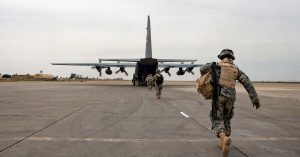
He then served three years with a patrol squadron based in Jacksonville, FL., where Ramey flew P-3 patrol planes, and helped conduct anti-submarine and counter-drug missions. His squadron’s efforts led to the seizure of more than $100 million in illegal drugs. Ramey also served as the safety officer and helped create an electronic template to determine how risky a flight was by analyzing weather elements such as temperature and wind speed. The Navy used his method as a blueprint for establishing effective safety programs for several squadrons.
Ramey then returned to the flight school at Corpus Christi as an instructor pilot. He was soon promoted to an instructor training unit officer, which required him to schedule and monitor training for more than 35 new instructor pilots.
Although he enjoyed the Navy, by the summer of 2001 Ramey wanted to try his hand as a civilian commercial pilot. Besides, he was getting married and planned to move to Philadelphia, where his wife’s job was. So, on the recommendation of friends, he applied for a pilot’s job with American Airlines and was hired in July of that year. But then came the terrorist attacks of Sept. 11, 2001. The travel industry collapsed and hundreds of pilots like Ramey were laid off.
But unlike many pilots, Ramey had choices. He worked as a full-time reservist until 2003, serving with a patrol squadron in Willow Grove, PA. In 2003 he entered The Home Depot’s prestigious Store Leadership Program — which targets junior military officers — and was made an assistant store manager in Philadelphia. But by late 2004, Ramey missed flying. He heard that JetBlue was looking for pilots, so he applied and was hired in June 2005.
“I missed the flexibility and adventure of flying,” Ramey says. “I can’t tell you how happy I am to be with this company. I’m a firm believer in the idea that you should pursue a career that you would do for free. For me, it’s that way with flying.”
When asked what advice he would give to those thinking about leaving the military, he said:
Spend a lot of time figuring out what your skills are and how they translate to civilian employment. “Employers know how disciplined and mission-oriented you are. But you have to relate your military skills on a civilian level.”
Find a career in which you would work for free. “Be happy in what you’re doing. There’s no point staying in a job you hate, no matter what you’re getting paid.”
Get as much education as you can in the military. “Use your G.I. Bill benefits, get as much training as you can while in the military, and take advantage of any transition assistance programs.”