President
Barack Obama opened the annual State of the Union Address before Congress last
night talking about America’s military. He ended it the same way. The address
included a proposal for a Veterans Jobs Corps.
“And tonight, I'm proposing a
Veterans Jobs Corps that will help our communities hire veterans as cops and
firefighters, so that America is as strong as those who defend her,” Obama
said.
More details about that as they
become available.
In case
you missed the speech, only saw part of it or nodded off during the lengthy
address, here is what he had to say about the military community:
Mr. Speaker, Mr. Vice President,
members of Congress, distinguished guests, and fellow Americans:
Last month, I went to Andrews Air
Force Base and welcomed home some of our last troops to serve in Iraq.
Together, we offered a final, proud salute to the colors under which more than
a million of our fellow citizens fought – and several thousand gave their
lives.
We gather tonight knowing that this
generation of heroes has made the United States safer and more respected around
the world. (Applause.) For the first time in nine years, there are no Americans
fighting in Iraq. (Applause.) For the first time in two decades, Osama bin
Laden is not a threat to this country. (Applause.) Most of al Qaeda's top
lieutenants have been defeated. The Taliban's momentum has been broken, and
some troops in Afghanistan have begun to come home.
These achievements are a testament
to the courage, selflessness and teamwork of America's Armed Forces. At a time
when too many of our institutions have let us down, they exceed all
expectations. They're not consumed with personal ambition. They don't obsess
over their differences. They focus on the mission at hand. They work together. 
Imagine what we could accomplish if
we followed their example. (Applause.) Think about the America within our
reach: A country that leads the world in educating its people. An America that
attracts a new generation of high-tech manufacturing and high-paying jobs. A
future where we're in control of our own energy, and our security and
prosperity aren't so tied to unstable parts of the world. An economy built to
last, where hard work pays off, and responsibility is rewarded.
We can do this. I know we can,
because we've done it before. At the end of World War II, when another
generation of heroes returned home from combat, they built the strongest
economy and middle class the world has ever known. (Applause.) My grandfather,
a veteran of Patton's Army, got the chance to go to college on the GI Bill. My
grandmother, who worked on a bomber assembly line, was part of a workforce that
turned out the best products on Earth.
The two of them shared the optimism
of a nation that had triumphed over a depression and fascism. They understood
they were part of something larger; that they were contributing to a story of
success that every American had a chance to share – the basic American promise
that if you worked hard, you could do well enough to raise a family, own a
home, send your kids to college, and put a little away for retirement.
The defining issue of our time is
how to keep that promise alive. No challenge is more urgent. No debate is more
important. We can either settle for a country where a shrinking number of
people do really well while a growing number of Americans barely get by, or we
can restore an economy where everyone gets a fair shot, and everyone does their
fair share, and everyone plays by the same set of rules. (Applause.) What's at
stake aren't Democratic values or Republican values, but American values. And
we have to reclaim them …
… Ending the Iraq war has allowed us to strike
decisive blows against our enemies. From Pakistan to Yemen, the al Qaeda
operatives who remain are scrambling, knowing that they can't escape the reach
of the United States of America. (Applause.)
From this position of strength,
we've begun to wind down the war in Afghanistan. Ten thousand of our troops
have come home. Twenty-three thousand more will leave by the end of this
summer. This transition to Afghan lead will continue, and we will build an
enduring partnership with Afghanistan, so that it is never again a source of
attacks against America. (Applause.)
As the tide of war recedes, a wave
of change has washed across the Middle East and North Africa, from Tunis to
Cairo; from Sana'a to Tripoli. A year ago, Qaddafi was one of the world's
longest-serving dictators – a murderer with American blood on his hands. Today,
he is gone. And in Syria, I have no doubt that the Assad regime will soon
discover that the forces of change cannot be reversed, and that human dignity
cannot be denied. (Applause.)
How this incredible transformation
will end remains uncertain. But we have a huge stake in the outcome. And while
it's ultimately up to the people of the region to decide their fate, we will
advocate for those values that have served our own country so well. We will
stand against violence and intimidation. We will stand for the rights and
dignity of all human beings -- men and women; Christians, Muslims and Jews. We
will support policies that lead to strong and stable democracies and open
markets, because tyranny is no match for liberty.
And we will safeguard America's own
security against those who threaten our citizens, our friends, and our
interests. Look at Iran. Through the power of our diplomacy, a world that was
once divided about how to deal with Iran's nuclear program now stands as one.
The regime is more isolated than ever before; its leaders are faced with
crippling sanctions, and as long as they shirk their responsibilities, this
pressure will not relent.
Let there be no doubt: America is
determined to prevent Iran from getting a nuclear weapon, and I will take no
options off the table to achieve that goal. (Applause.)
But a peaceful resolution of this
issue is still possible, and far better, and if Iran changes course and meets
its obligations, it can rejoin the community of nations.
The renewal of American leadership
can be felt across the globe. Our oldest alliances in Europe and Asia are
stronger than ever. Our ties to the Americas are deeper. Our ironclad
commitment – and I mean ironclad – to Israel's security has meant the closest
military cooperation between our two countries in history. (Applause.)
We've made it clear that America is
a Pacific power, and a new beginning in Burma has lit a new hope. From the
coalitions we've built to secure nuclear materials, to the missions we've led
against hunger and disease; from the blows we've dealt to our enemies, to the
enduring power of our moral example, America is back.
Anyone who tells you otherwise,
anyone who tells you that America is in decline or that our influence has
waned, doesn't know what they're talking about. (Applause.) That's not the message we get from
leaders around the world who are eager to work with us. That's not how people
feel from Tokyo to Berlin, from Cape Town to Rio, where opinions of America are
higher than they've been in years. Yes, the world is changing. No, we can't
control every event. But America remains the one indispensable nation in world
affairs – and as long as I'm President, I intend to keep it that way.
(Applause.)
That's why, working with our
military leaders, I've proposed a new defense strategy that ensures we maintain
the finest military in the world, while saving nearly half a trillion dollars
in our budget. To stay one step ahead of our adversaries, I've already sent
this Congress legislation that will secure our country from the growing dangers
of cyber-threats. (Applause.)
Above all, our freedom endures
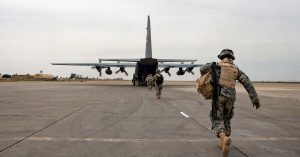
because of the men and women in uniform who defend it. (Applause.) As they come
home, we must serve them as well as they've served us. That includes giving
them the care and the benefits they have earned – which is why we've increased
annual VA spending every year I've been President. (Applause.) And it means
enlisting our veterans in the work of rebuilding our nation.
With the bipartisan support of this
Congress, we're providing new tax credits to companies that hire vets. Michelle
and Jill Biden have worked with American businesses to secure a pledge of
135,000 jobs for veterans and their families. And tonight, I'm proposing a
Veterans Jobs Corps that will help our communities hire veterans as cops and
firefighters, so that America is as strong as those who defend her. (Applause.)
Which brings me back to where I
began. Those of us who've been sent here to serve can learn a thing or two from
the service of our troops. When you put on that uniform, it doesn't matter if
you're black or white; Asian, Latino, Native American; conservative, liberal;
rich, poor; gay, straight. When you're marching into battle, you look out for
the person next to you, or the mission fails. When you're in the thick of the
fight, you rise or fall as one unit, serving one nation, leaving no one behind.
One of my proudest possessions is
the flag that the SEAL Team took with them on the mission to get bin Laden. On
it are each of their names. Some may be Democrats. Some may be Republicans. But
that doesn't matter. Just like it didn't matter that day in the Situation Room,
when I sat next to Bob Gates – a man who was George Bush's defense secretary – and
Hillary Clinton – a woman who ran against me for president.
All that mattered that day was the
mission. No one thought about politics. No one thought about themselves. One of
the young men involved in the raid later told me that he didn't deserve credit
for the mission. It only succeeded, he said, because every single member of
that unit did their job – the pilot who landed the helicopter that spun out of
control; the translator who kept others from entering the compound; the troops
who separated the women and children from the fight; the SEALs who charged up
the stairs. More than that, the mission only succeeded because every member of
that unit trusted each other – because you can't charge up those stairs, into
darkness and danger, unless you know that there's somebody behind you, watching
your back.
So it is with America. Each time I
look at that flag, I'm reminded that our destiny is stitched together like
those 50 stars and those 13 stripes. No one built this country on their own.
This nation is great because we built it together. This nation is great because
we worked as a team. This nation is great because we get each other's backs.
And if we hold fast to that truth, in this moment of trial, there is no
challenge too great; no mission too hard. As long as we are joined in common
purpose, as long as we maintain our common resolve, our journey moves forward,
and our future is hopeful, and the state of our Union will always be strong.
Thank you, God bless you, and God
bless the United States of America. (Applause.)