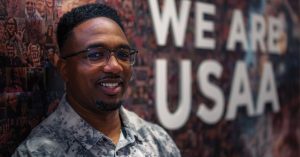
Assistant Manager at Walgreens
Marine Corps infantryman finds the formula for civilian career success with Walgreens.
by Warren Duffie
How does a Marine Corps infantryman find success in retail store management? Are there any similarities between hauling a machine gun and loading shelves with new merchandise?
Micah Marmaro says there are two common intangibles: discipline and teamwork.
“You have to be willing to work hard and learn everything about your store,” says Marmaro, 22. “You also have to keep your employees happy in order to run a productive store. That’s why teamwork is so vital. In combat it keeps you alive, but in business it keeps your sales up. My military experience helps me motivate people to work well as a unit.”
On the Job
Marmaro, a former corporal, is an assistant manager at a Walgreens drugstore in Aurora, Colo. Each day is a flurry of activity. The ex-infantryman works nine- to 10-hour shifts filled with everything from ringing up sales, manning the photo lab, setting up store signage, planning employee schedules, and customer service.
"One thing I love about this job is that it’s always changing,” Marmaro says. “There’s always more to do, which is good for me since I don’t like to sit around.”
Walgreens is the nation’s largest drugstore chain — with fiscal 2006 sales of $47.4 billion. The company operates 5,584 stores in 48 states and Puerto Rico, including 76 Happy Harry’s stores in Delaware and surrounding states. Walgreens also provides additional services to pharmacy patients and prescription drug and medical plans through Walgreens Health Services, its managed care division, which includes Walgreens Health Initiatives Inc. (a pharmacy benefits manager), Walgreens Mail Service Inc., Walgreens Home Care Inc. and Walgreens Specialty Pharmacy.
“Military veterans are ideal for the retail environment,” Marmaro says. “There is no stagnant job. You can work at the lowest level and move up. Even our CEO started out as a store associate. The environment is dynamic and you’re always on the move - something veterans are used to.”
Military Experience
Marmaro, an Aurora native, enlisted in the Marine Corps in 2002 after graduating from high school. Upon completing basic training in San Diego, he attended infantry school at nearby Camp Pendleton, Calif. After two years, he joined the Marine’s security forces and was stationed at Patuxent River, Md.
From 2005 to 2006, Marmaro served on a base in the Ar-Ramadi province of Iraq, which is two hours west of Baghdad. There, he was part of a security detail guarding the base and looking out for improvised explosive devices (IEDs) on the two-mile road leading out from the installation.
“We had a few firefights, but nothing major, since we weren’t out in the field very much,” Marmaro says.
The Transition
When he returned to the United States last year, Marmaro knew he wanted to leave the military. He had gotten engaged while in Iraq and didn’t want to deploy again. Plus, he wanted to pursue degrees in engineering and finance (he’s currently attending night school).
So Marmaro attended various transition assistance classes — “an excellent resource” — and asked his uncle and father for résumé help. Soon thereafter, he made a connection with Walgreens.
“I really liked what I heard about the company,” he says. “Walgreens has been around for more than 100 years, so it’s very stable. It’s also America’s largest drugstore chain and offers myriad career opportunities — from legal to finance to loss prevention to sales.”
The pay isn’t bad either. As an assistant manager, Marmaro has already eclipsed his military salary; and when he’s promoted to store manager, he’ll be eligible for bonuses and a percentage of store profits.
“Walgreens is a great career for transitioning veterans,” Marmaro says. “It really gets you back in the groove of civilian life, you’re usually hired quickly [within three to four weeks], and the growth potential is unlimited. Plus, the company really values veterans and is very patriotic.”
Marmaro’s Advice
Research your options. “Figure out what you want to do and what career path you want.”
Don’t second-guess yourself. “Your military skills are extremely valuable. Even if you have to learn a new job, employers know veterans are calm under pressure and won’t panic. These qualities are extremely attractive.”
Be ambitious. “Don’t just settle for the first job that comes along. If you don’t like a job, don’t take it, or look for something that does interest you.”